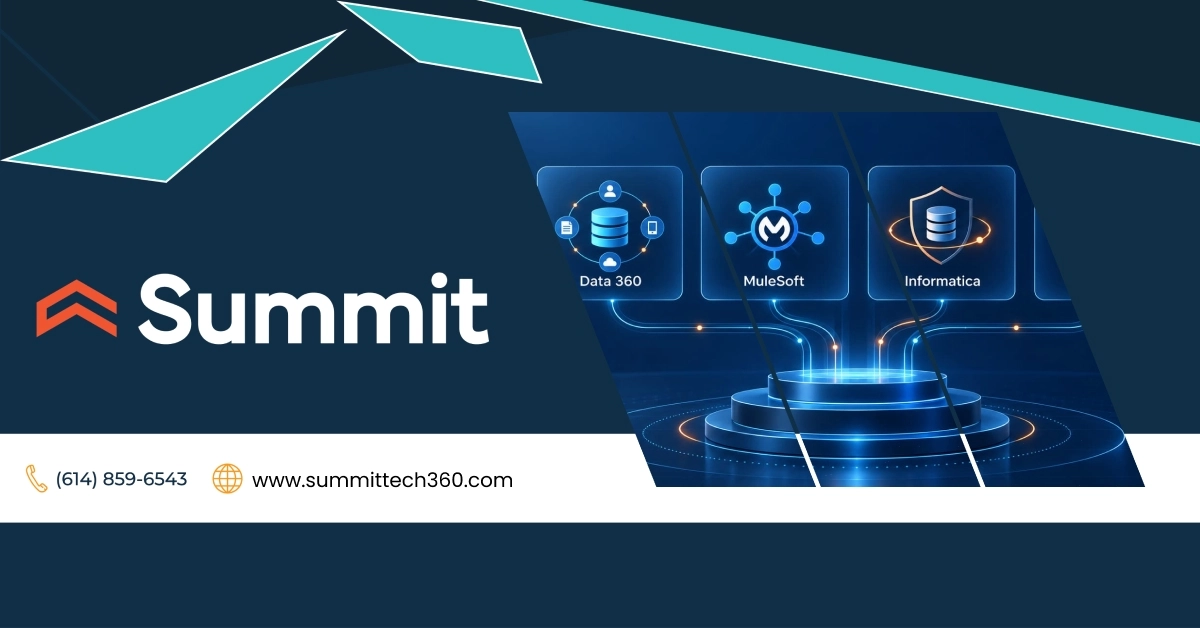
Salesforce has built a much broader data foundation than many Salesforce customers may realize. Data 360, MuleSoft, Informatica, and Tableau span data access, integration, management, governance, and analytics. Each plays a distinct role, but their capabilities increasingly intersect and work together. This guide explains where each offering fits, where their roles overlap, and how they can fit alongside the systems and data investments you already have.
What Is the Salesforce Data Foundation?
Salesforce’s data foundation brings together capabilities across Data 360, MuleSoft, Informatica, and Tableau to help organizations connect, integrate, manage, govern, and analyze data.
A helpful way to understand the breadth of Salesforce’s data foundation — and why some capabilities overlap — is to look at how Salesforce assembled it. Data 360, formerly Data Cloud, grew from Salesforce’s own customer data platform work, while MuleSoft, Tableau, and Informatica joined Salesforce through major acquisitions.
How Salesforce Expanded Its Data Capabilities Over Time
- Salesforce acquired MuleSoft in 2018. The acquisition added capabilities for connecting enterprise applications, data, and devices across cloud and on-premises environments.
- Salesforce acquired Tableau in 2019. The acquisition added enterprise analytics capabilities for exploring, visualizing, and analyzing data across a wide range of sources and use cases.
- Data 360, formerly Data Cloud. Salesforce’s customer data platform evolved into Data Cloud, expanding beyond its original Marketing Cloud focus to support use cases across Customer 360. Salesforce renamed Data Cloud to Data 360 on October 14, 2025. Summit’s guide to Salesforce Data 360 explores the platform in more depth.
- Salesforce acquired Informatica in 2025. The acquisition added extensive enterprise data management capabilities, including data integration, quality, governance, metadata management, and Master Data Management (MDM). In May 2026, Salesforce described Informatica as part of “Salesforce’s data foundation — alongside Data 360, MuleSoft, and Tableau.”
Those capabilities have distinct roles, but some overlap. Salesforce describes MuleSoft’s application integration and API management as complementary to Informatica’s data integration and governance capabilities. It also describes Informatica as strengthening Data 360 in areas such as data quality and governance while providing richer data context for Tableau.
With that context, the individual roles should become easier to understand. We’ll look at each offering first, and then later explore where they work together and where their roles overlap.
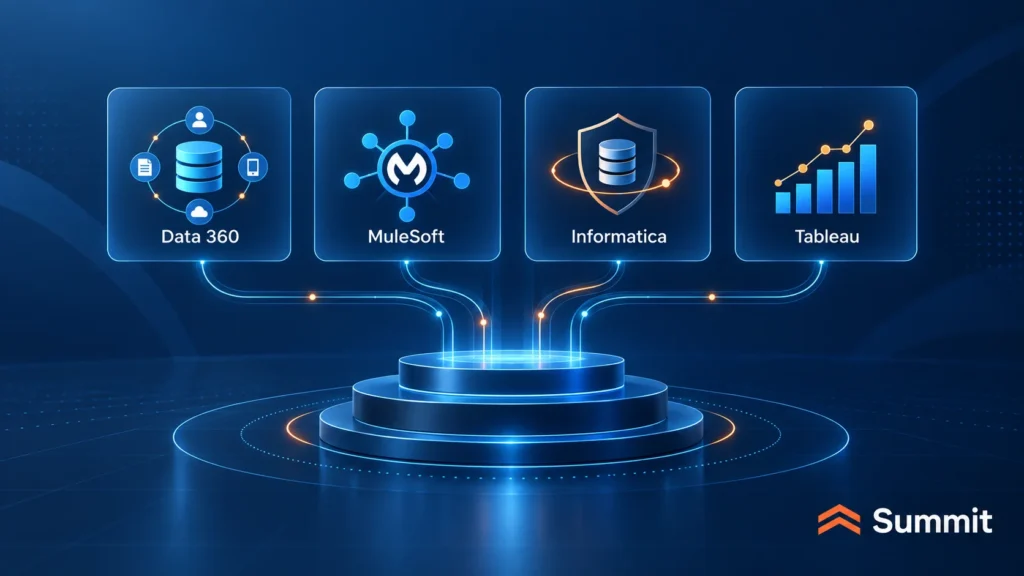
Where Data 360 Fits: Bringing More Business Context Into Salesforce
In most organizations, Salesforce holds important customer and account information, but often only part of the context needed to understand a customer or situation. Orders and invoices may live in ERP. Product usage may be captured in another platform. Service history may span several applications.
Data 360 connects information from Salesforce and other systems, making more business context available across Salesforce applications, analytics, automation, and AI.
Here are two examples to show how that broader context can change what a team sees before it acts:
- A commercial banker. A company reaches out and appears to be a new prospect. Elsewhere in the bank, that company already has treasury accounts, a recent lending decision, and an open fraud dispute. Bringing those signals into the Salesforce view gives the relationship manager important context before the conversation begins.
- A manufacturer’s service team. A customer reports an equipment issue in Salesforce. Order history sits in ERP, warranty and entitlement information lives elsewhere, and previous equipment activity is stored in another system. Bringing the relevant information together can help the team understand both the customer and the equipment history without manually piecing information together across applications.
These examples reinforce that useful context depends on the decision or workflow. A seller, service representative, analyst, or AI agent may each need different information. Data 360 can make that context available for Salesforce use cases, while the systems that originally manage it continue to serve their broader roles.
For more on Data 360 and how the platform can fit with existing data investments, see Summit’s Salesforce Data 360 guide.
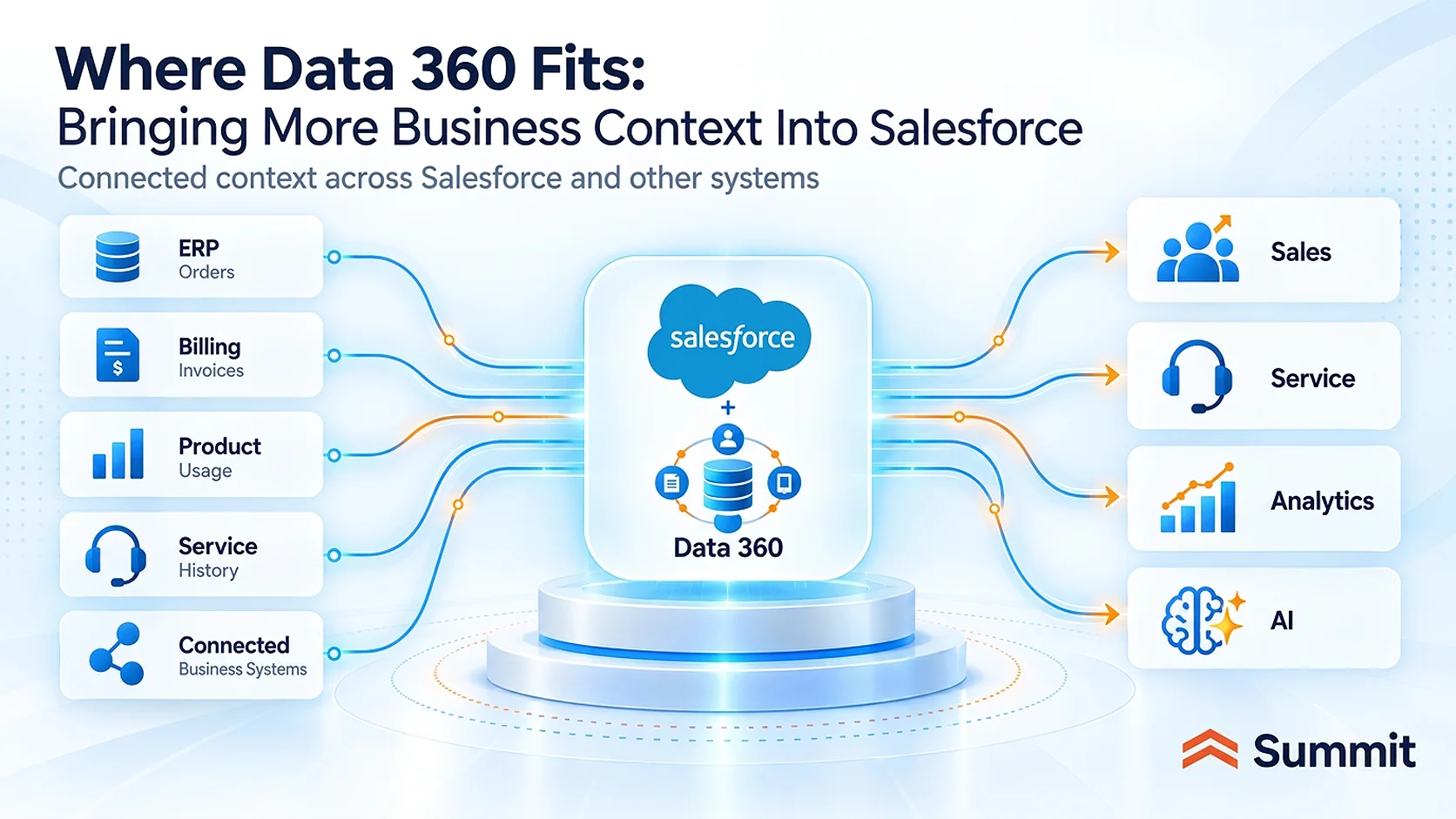
Where MuleSoft Fits: Connecting Applications and Business Processes
MuleSoft provides integration and API capabilities for connecting applications, data, and systems across cloud and on-premises environments.
Here are two Salesforce-centered examples to show how MuleSoft can support a process that crosses system boundaries:
- Revenue operations. A deal closes in Salesforce. An order needs to be created in ERP. The customer’s service profile may need to be created or updated in a provisioning platform. Billing needs to begin, and the services team may need information to start implementation. MuleSoft can connect the applications involved so the required information reaches each system without relying on a chain of manual handoffs.
- State and local government. A permit clears final review. A fee may need to be posted in the financial system, an inspection scheduled in another application, and an update sent to the applicant. MuleSoft can coordinate those interactions across the systems involved so the process can continue without requiring staff to re-enter the same information across multiple applications.
What these examples have in common is that Salesforce is one part of a broader process. MuleSoft helps keep the necessary information and actions moving across the systems involved.
MuleSoft also supports an API-led approach to integration, which emphasizes governed, reusable connections rather than one-off integrations. If your organization manages many integrations, that can reduce the need to rebuild access to the same application or data every time another process needs it.
For more on common Salesforce integration needs, planning considerations, and mistakes to avoid, see Summit’s Salesforce Integration guide
Where Informatica Fits: Strengthening Trust in Enterprise Data
As your organization connects more systems and brings more data together, the quality and trustworthiness of that data matter more. Informatica helps connect, improve, manage, and govern data across the enterprise so teams can use it more reliably across systems, analytics, and AI.
Salesforce’s State of Data & Analytics research puts the scale of that challenge in perspective: data and analytics leaders estimate that 26% of their organizations’ data is untrustworthy.
Summit explored this challenge in our analysis of the Salesforce-Informatica acquisition, including why data quality, governance, and lineage matter more as organizations rely on enterprise data for analytics and AI.
To make that role more concrete, here are two familiar data problems that show why trust still matters as information moves across systems:
- Product data. The same product may appear as AX-500 in Salesforce, AX500 in ERP, and under an older product code in another system. Informatica can help standardize and govern those records so the organization can maintain more consistent product information across systems.
- Executive reporting. A dashboard may show $18.7 million in pipeline, but a business or data leader may need to know which systems contributed to that number and what happened to the data before it reached the dashboard. Informatica can help trace where the data came from, how it changed, and where it is being used. That traceability is commonly referred to as data lineage.
The takeaway is straightforward: bringing more data together does not, on its own, make the data trustworthy. Quality, consistency, and traceability still need to be managed.
Informatica also provides Master Data Management (MDM), which helps organizations create, manage, and govern trusted master records for important business entities such as customers, products, and suppliers. In the product example above, MDM could help establish a governed product record that serves as an authoritative reference across the organization.
Salesforce is also maintaining Informatica's broader enterprise reach. Informatica continues to support heterogeneous and multicloud data environments, including platforms outside Salesforce. Newer capabilities are designed to expose trusted data-management services across applications, platforms, and AI environments, allowing Informatica to serve as part of the Salesforce data foundation without requiring the broader enterprise data estate to move into Salesforce.
For Summit’s perspective on the acquisition and what it may mean for customers and the Salesforce ecosystem, see our Salesforce-Informatica acquisition analysis.
Where Tableau Fits: Analyzing and Visualizing Data Across the Enterprise
Well-connected, well-governed data still has to be understandable to the people making decisions and taking actions based on it. Tableau provides analytics and business intelligence capabilities for exploring, analyzing, and visualizing data from Salesforce and other business systems.
For leaders and teams, that means being able to monitor performance, spot trends, investigate what is driving a result, and bring information from different parts of the business into the same analysis.
Salesforce research shows why that capability is important. Only 49% of business leaders say they can reliably generate timely insights. More data alone does not guarantee that leaders can quickly understand what is happening or why performance is changing.
Consider a manufacturer whose revenue is rising while margins are falling. Sales information may be in Salesforce, orders and revenue in ERP, and warranty or service costs in other systems. Tableau can bring those measures into a single analysis, allowing leaders to compare products, regions, or customer segments and investigate what may be contributing to the margin decline. That gives leaders more than a view of the margin decline; it gives them a way to investigate what may be driving it across the business.
Salesforce has also expanded the Tableau portfolio. Alongside established offerings such as Tableau Cloud and Tableau Server, Salesforce has introduced Tableau Semantics and Tableau Next, expanding how Tableau fits into Salesforce’s broader data foundation.
Tableau Semantics: Giving Data Consistent Business Meaning
As more data sources and analytics experiences come together, organizations need a consistent way to define the business terms behind the numbers.
Salesforce research found that 49% of data and analytics leaders say their companies occasionally or frequently draw incorrect conclusions from data with poor business context.
- Example: defining an active customer. Sales might base the definition on recent activity or opportunities, Finance on a current contract, and Service on an active entitlement. Each definition may make sense for a particular purpose, but they may not answer the same question consistently.
Tableau Semantics provides a governed way to define business terms, metrics, and logic. It maps underlying data to familiar business terms and standardized logic so concepts such as revenue, retention, or active customer can be interpreted consistently across supported analytics and AI experiences.
Tableau Next: Exploring Data Through Conversational Analytics
Tableau Next is Salesforce’s AI-powered analytics experience, including conversational analytics through Tableau Agent.
Instead of first locating the right report or dashboard, choosing filters, and determining how to drill into the data, a user can simply ask what they want to understand in natural language.
From a Tableau Next dashboard or metric page, a user can open Tableau Agent and type a question. Tableau Agent can respond with a conversational answer and relevant visualizations, and the user can continue with follow-up questions to investigate the result further.
A sales leader, for example, could ask, “Why did sales decline in the Northeast last quarter?” The response could include an explanation and supporting visualizations, followed by deeper questions about specific products, customers, or other factors that may be contributing to the decline.
When configured, Tableau Agent can also support conversational analytics in Salesforce and Slack, so users can ask questions in those environments rather than returning to Tableau Next for every interaction.
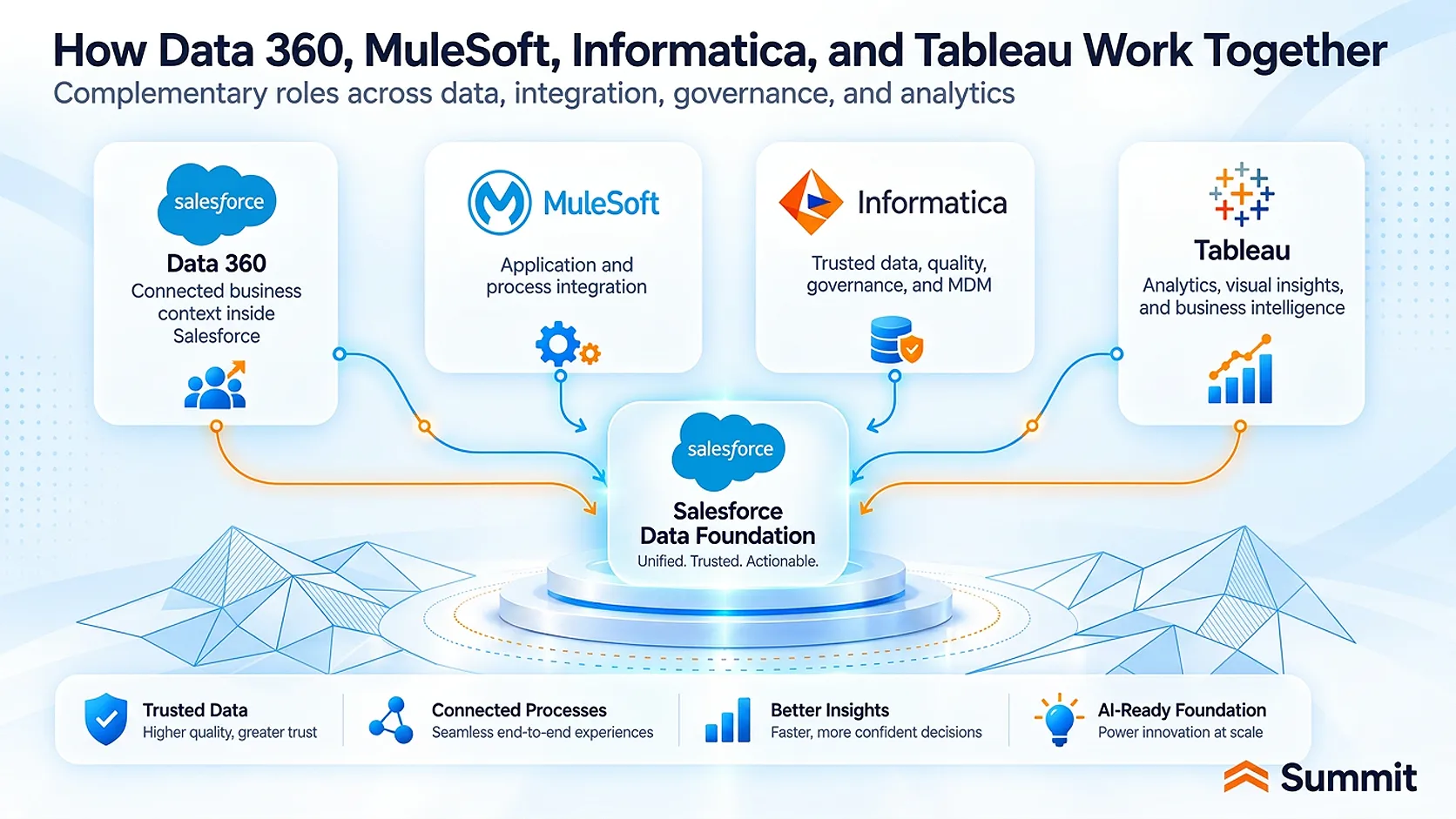
How Data 360, MuleSoft, Informatica, and Tableau Work Together
A number of these capabilities complement — and sometimes overlap with — one another.
Here are three common combinations to show how they can work together:
Informatica + Data 360: Give Salesforce Users and AI More Complete, Trustworthy Information
Customer or product data may be duplicated, incomplete, or inconsistent across Salesforce, ERP, billing, and other systems.
Informatica can standardize, deduplicate, enrich, and govern those records.
Data 360 can then combine that trusted data with transactions, service activity, engagement, and other information, giving Salesforce users and AI use cases a broader business view.
Salesforce specifically positions Informatica and Data 360 as complementary, with Informatica contributing trusted, cleansed, governed data that can be used in Salesforce use cases.
Data 360 + MuleSoft: Use Salesforce Information to Drive Action Across Systems
Data 360 can make order, billing, service, product, and other external information available for use in Salesforce. In many workflows, making the information available in Salesforce is only the first step. A Salesforce process may also need to create or update a record in ERP, a billing system, a fulfillment application, or another platform.
MuleSoft can connect the applications and pass the information required to continue that process. Salesforce also provides a MuleSoft connector for connecting business applications and external systems with Data 360, including SaaS and legacy applications.
Data 360 + Tableau: Analyze Connected Data Using Consistent Business Definitions
Salesforce describes Data 360, Tableau Semantics, and Tableau Next as a connected ecosystem for moving from data to analysis and insights.
Data 360 can make information from Salesforce and other sources available for analysis.
Tableau gives people across the organization ways to explore and visualize that information, while Tableau Semantics can add consistent business definitions and metrics.
That combination is particularly useful when measures such as revenue, retention, or customer value need to mean the same thing across supported analytics and AI experiences.
How Salesforce Is Using These Capabilities Together
Salesforce itself provides a useful example of how several of these capabilities can work together.
In a 2026 joint-positioning brief, Salesforce says its account and product data had become fragmented across multiple Salesforce orgs and external systems. Salesforce used Informatica Master Data Management to standardize and govern the data, MuleSoft to distribute those records across systems, and Data 360 to use the trusted information across analytics, automation, and AI.
Salesforce reports 20% fewer duplicate accounts and a 98% reduction in tax adjustments from this approach.
Where Their Roles Overlap
Because these offerings address related parts of the same data environment, some of their capabilities naturally overlap. That can make it difficult to know which one fits a particular need. A practical way to sort through the differences is to look at the primary problem each is designed to solve.
Data 360 + Informatica: Both Can Bring Information From Multiple Systems Together
Both Data 360 and Informatica can integrate data from multiple sources.
- Data 360 connects, harmonizes, and links information from different sources so Salesforce can use a more complete view while retaining the underlying source data.
- Informatica integrates data from multiple systems and adds broader capabilities for data quality, standardization, governance, ongoing data management, and Master Data Management.
Salesforce provides more detail in its current guidance on how Data 360 and Informatica differ and work alongside one another.
MuleSoft + Informatica: Both Support Integration
If you are comparing MuleSoft and Informatica, the word “integration” can make them sound more interchangeable than they are. Their primary focus differs:
- MuleSoft focuses on connecting applications and coordinating cross-system processes. Salesforce and ERP, for example, may need to exchange records and coordinate an order, billing, or service process.
- Informatica focuses more broadly on integrating and managing the data itself, including movement and transformation, quality, standardization, governance, and master data.
Salesforce describes MuleSoft and Informatica as complementary rather than interchangeable, distinguishing application connectivity and orchestration from broader data management.
Data 360 + MuleSoft: Both Can Connect Salesforce With External Data and Systems
Both Data 360 and MuleSoft can help Salesforce work with information that lives elsewhere. The distinction often comes down to what your business needs to do with that information:
- Data 360 provides ways to connect and access external data so the information can be used across Salesforce. Salesforce supports connectors, data ingestion, and zero-copy access for supported external platforms.
- MuleSoft connects applications and coordinates interactions between them. This is especially useful when two or more applications need to exchange records or complete steps in the same business process.
Salesforce provides more detail on Data 360 connectivity options and the MuleSoft connector for Data 360 in its documentation.
Here’s a way to think about this relationship: Data 360 may make order and account information available to a service team in Salesforce. If resolving the issue also requires a return record to be created in ERP and the new status sent back to Salesforce, MuleSoft can connect the applications and pass the required updates between them.
These offerings can work together, but they are not interchangeable. The right mix depends on the systems already in place, the data and integration requirements, and the capabilities the business actually needs.
How Salesforce’s Data Foundation Can Fit Your Existing Data Environment
Most organizations are not starting from scratch with their data environments. Some have Salesforce at the center of the business, surrounded by ERP, e-commerce, finance, service, and other applications. Others already have mature integration platforms, enterprise analytics, cloud data warehouses or lakehouses, and Master Data Management in place.
Salesforce’s data foundation can play different roles across that spectrum. As the surrounding data environment becomes more established, Salesforce’s role can shift from providing more of the capability directly to connecting with and extending platforms already in place.
Salesforce at the Center, With Business Systems Around It
Your environment may already look something like this: Salesforce supports sales and service, while an ERP such as SAP or Oracle NetSuite runs other core parts of the business. E-commerce may sit in Shopify or Adobe Commerce, with separate applications for billing, finance, fulfillment, or other operations.
In that environment, Salesforce may hold the sales and service relationship while important customer and business information lives elsewhere. A sales or service team might benefit from seeing:
- order and purchase history from ERP or commerce;
- billing and payment information;
- product, inventory, or fulfillment information; and
- service activity held outside Salesforce.
Salesforce’s broader data foundation can support that environment in several ways:
- Data 360 can make selected information from those systems available in Salesforce, giving users more customer and account context while supporting automation, analytics, and AI use cases.
- MuleSoft can connect the applications when the process itself crosses system boundaries. A Salesforce action might need to create or update a record in ERP, initiate billing, send information to fulfillment, or return a status update to Salesforce.
- Tableau can give leaders a broader view of performance by analyzing information across Salesforce and other business sources.
- Informatica can add broader capabilities for data quality, governance, integration, and Master Data Management as data becomes more distributed or difficult to manage consistently.
Those systems do not need to stop doing the jobs they were designed for. Salesforce can connect to the information and processes its users need while ERP, commerce, billing, service, and other applications continue serving their broader roles.
Salesforce Alongside Existing Integration and Analytics Technology
Your organization may already have technology that connects applications or supports analytics across the business — for example, Boomi or Workato for integration or Microsoft Power BI for established reporting and analytics.
Adding Salesforce’s newer data capabilities does not automatically mean replacing technology that already works. The goal is to determine where Salesforce adds value within the architecture you already have.
An organization could continue using existing integrations that work well while introducing MuleSoft for particular Salesforce-centered processes. It could keep established enterprise reporting in Power BI while using Data 360 to make more external data available within Salesforce for users and use cases involving automation and AI.
In this kind of environment, Salesforce may provide specific capabilities inside an established architecture rather than becoming the platform for every integration, data, or analytics need.
Salesforce Within a More Mature Enterprise Data Architecture
The same principle applies in a more mature enterprise data environment, where dedicated cloud data platforms, enterprise integration technology, Master Data Management, governance, and analytics may already be in place.
If your organization already relies on a data warehouse or lakehouse such as Snowflake, Databricks, Google BigQuery, or Amazon Redshift, Data 360 can work with supported external platforms through zero-copy federation. That allows selected data to remain in the external platform while becoming available for Salesforce use cases.
The warehouse or lakehouse can continue to support enterprise analytics, data science, and other workloads, while Salesforce uses selected data for CRM, automation, analytics, and AI.
Your organization may also already use Master Data Management through a platform such as Reltio, SAP Master Data Governance, or Stibo Systems. If that platform already governs master customer or product data, it can continue performing that role.
Data 360 can use identifiers from external MDM systems when matching records, allowing identifiers from governed master records to contribute to the broader Salesforce view without requiring Data 360 to become the organization’s MDM system.
In a mature enterprise architecture, Salesforce does not need to own every data function. It can connect to established platforms and extend selected data into Salesforce experiences where it adds value.
How Newer Tableau Capabilities Can Fit Existing Environments
If your organization already relies on Tableau Cloud or Tableau Server, adopting Tableau Next or Tableau Semantics does not require replacing that environment. Salesforce continues to invest in its established Tableau offerings while expanding how the portfolio works together.
Organizations can introduce Tableau Next and Tableau Semantics, where conversational analytics, AI, or more consistent business definitions add value, while existing Tableau environments continue to support established analytics needs. Salesforce describes the Tableau portfolio as interoperable across Tableau Cloud, Tableau Server, Tableau Next, and CRM Analytics.
The right combination will depend on the Tableau environment already in place, who uses analytics, and the business decisions those tools need to support.
If you are evaluating how Tableau, Tableau Next, Tableau Semantics, and other analytics capabilities should fit your environment, Summit’s Analytics & Business Intelligence Services can help you align the approach
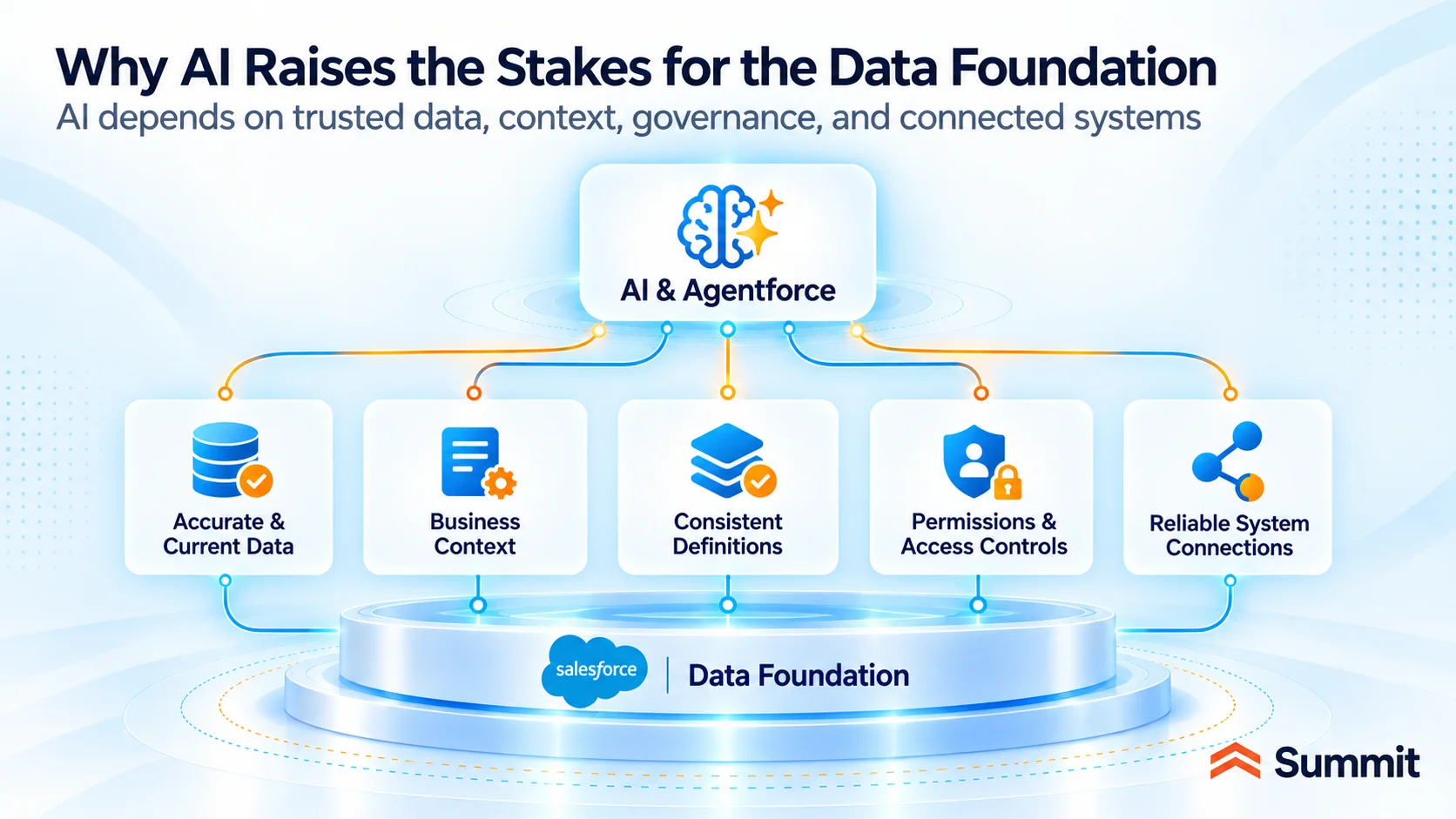
Why AI Raises the Stakes for the Data Foundation
As organizations use AI to do more than answer questions, the quality of the underlying data becomes more consequential. Recommendations, automated decisions, and actions are only as dependable as the information, permissions, definitions, and system connections behind them.
Salesforce’s research reinforces that connection. 89% of data and analytics leaders say a strong data foundation is the most critical factor for successful AI, while 84% say their data strategies need an overhaul to reach their AI goals.
For Salesforce customers, Agentforce makes that relationship concrete. Agents can use Salesforce data, knowledge, and information from connected systems to reason and carry out configured actions through workflows, APIs, and other connected business processes.
That puts specific demands on the data foundation supporting the agent:
- The data needs to be accurate and up to date, with governance in place to maintain quality and control its use.
- The agent needs the business context required for the task, including customer, product, transaction, service, or other information held outside Salesforce when the use case depends on it.
- Important business terms and metrics need consistent definitions, so the agent interprets information using the intended business meaning.
- Permissions and access controls need to match what the agent is allowed to see and do.
- Connections to other systems need to work reliably when the agent reads information from or updates records in those applications.
That is where the capabilities covered throughout this guide start to matter together:
- Data 360 can broaden the business context available in Salesforce.
- Informatica can strengthen the quality and governance of the underlying data.
- MuleSoft can connect AI-enabled workflows to the operational systems where actions need to occur.
- Tableau Semantics can help keep important business terms and metrics consistently defined.
Once an AI use case depends on several of these capabilities, the decisions are no longer limited to Agentforce itself. They become decisions about data, integration, analytics, governance, permissions, and how the broader environment should work together.
For a deeper look at Agentforce and AI readiness, we recommend these resources:
- What Is Salesforce Agentforce? explains Agentforce and autonomous AI agents.
- Is Your Data AI-Ready? examines seven critical factors including data quality, access, governance, integration, and ownership.
- AI Governance in Salesforce looks at permissions, guardrails, controls, and oversight for AI-enabled use cases.
The Salesforce-Anthropic Partnership Extends the Data Foundation Beyond Salesforce
Salesforce’s expanded partnership with Anthropic provides another example of why the data foundation increasingly matters beyond individual Salesforce applications. Through Claudeforce and Salesforce in Claude, Salesforce is making governed business data, workflows, business logic, and actions available directly to Claude.
The architecture uses Salesforce’s Headless 360 capabilities and Model Context Protocol (MCP) connections to give Claude access to enterprise context while preserving Salesforce permissions and business rules. Data 360 can provide unified business context, while Salesforce workflows and APIs allow AI experiences to move from understanding information to taking governed action.
The significance is broader than Claude itself. As organizations use multiple AI models and agent experiences, the data foundation increasingly becomes the layer that determines what those systems know, what business context they receive, and what they are permitted to do.
How Summit Helps Bring Salesforce and the Broader Data Environment Together
A Salesforce data initiative rarely stays confined to one product. A Data 360 project may depend on an external data platform. Integration work can expose data quality or governance gaps. Analytics depends on shared business definitions, and AI initiatives may rely on all of these plus permissions and business context.
Summit brings together deep Salesforce expertise with a dedicated Data, Analytics & AI Services practice. Our Data, Analytics & AI Advisory work is platform-agnostic, so we can evaluate Data 360, MuleSoft, Informatica, Tableau, and the technology already in place as part of the same environment.
We start with the business need and current architecture, then determine where capabilities should be connected, improved, implemented, or supported.
Depending on your current environment and business priorities, the right starting point may include:
- Determining how the capabilities should fit. Our Data, Analytics & AI Advisory helps leadership assess the current environment, evaluate technology options, and develop a roadmap tied to business goals.
- Assessing current data health. Our Data Health Check & Optimization services assess data quality, integration, governance, security, and related risks or gaps before making larger changes.
- Connecting or modernizing systems and data platforms. Our Data Integration & Platform Modernization services support work across CRM, ERP, cloud data platforms, and legacy environments. For Salesforce-centered application connections, Salesforce Integration Services focuses specifically on connecting Salesforce with ERP, finance, commerce, custom applications, and other business systems.
- Strengthening governance, privacy, or compliance. Our Data Governance & Compliance services address data ownership, quality, privacy, lineage, policies, and controls across the broader environment.
- Improving analytics and reporting. Our Analytics & Business Intelligence Services support Tableau, Salesforce analytics, and broader enterprise analytics environments.
- Supporting the environment after launch. Our Managed Data & AI Services provide ongoing monitoring, enhancement, optimization, and governance for data, analytics, and AI solutions.
Summit can support the work from advisory and implementation through ongoing optimization, even when the solution spans multiple Salesforce offerings and existing enterprise platforms.
If you are evaluating where Salesforce’s data foundation fits in your environment, get in touch to speak with one of our experts today about your data, analytics, or AI initiative.
Key Takeaways
- Salesforce’s data foundation is broader than Data 360. Salesforce now positions Data 360, MuleSoft, Informatica, and Tableau as parts of a broader foundation for connecting, managing, governing, and analyzing enterprise data.
- Each offering contributes something different. Data 360 brings broader business context into Salesforce. MuleSoft connects applications and business processes. Informatica adds enterprise data integration, quality, governance, and Master Data Management. Tableau provides enterprise analytics, with Tableau Semantics supporting consistent business definitions and Tableau Next extending the portfolio into AI-powered analytics.
- The offerings are complementary. Their capabilities can work together, and some of their roles overlap. Important overlap areas include Data 360 with Informatica, MuleSoft with Informatica, and Data 360 with MuleSoft.
- Salesforce’s role changes with the environment around it. A Salesforce-centered organization may use more of these capabilities directly. A more established enterprise data environment may connect Salesforce to existing data platforms, integration technology, MDM, or analytics tools.
- AI makes the data foundation more consequential. As Agentforce and other AI systems rely on more enterprise data and take on more responsibility, data quality, context, definitions, access, governance, and system connections become increasingly important.
Frequently Asked Questions About Salesforce's Data Foundation
What is Salesforce’s data foundation?
Salesforce’s data foundation is not a single standalone product. Salesforce uses the term for a broader set of capabilities that includes Data 360, MuleSoft, Informatica, and Tableau. Together, they span data connectivity, integration, data management and governance, analytics, and AI support.