Salesforce has quietly built one of the most capable AI governance platforms in enterprise software. For companies running Salesforce, much of the foundation for responsible, scalable AI is already built into the platform. Here is the business value of what’s there, why it matters right now, and how to leverage these capabilities in an AI governance program that holds up.
Why AI Governance in Salesforce Matters Now
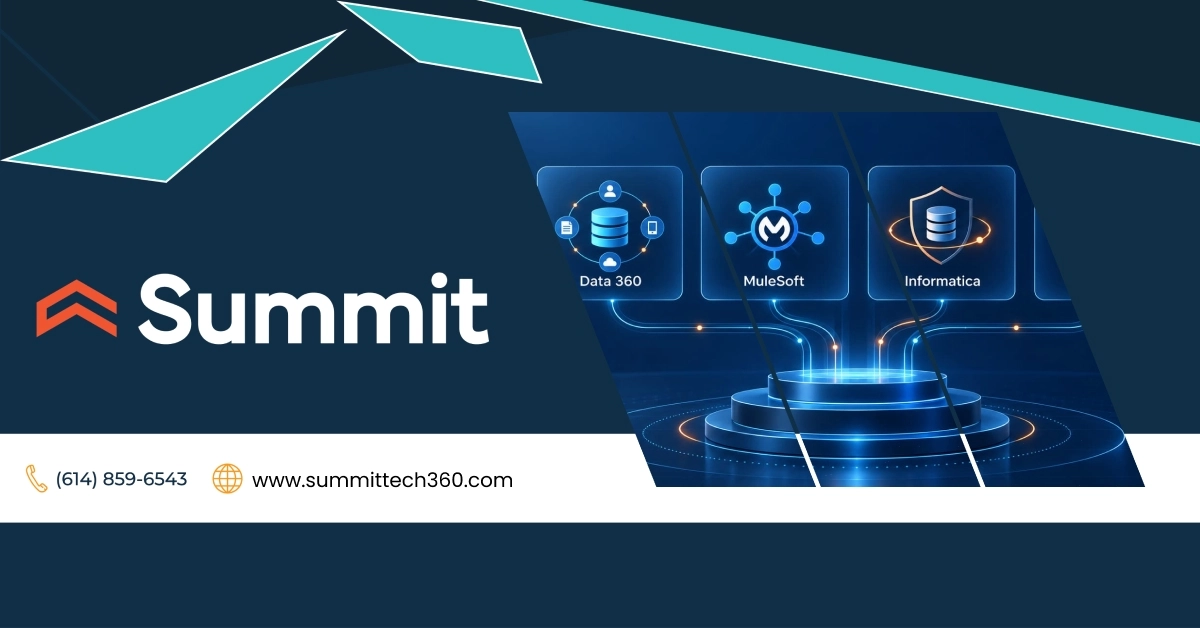
On October 13, 2025, at Dreamforce, Salesforce announced Agentforce 360, the platform that brings Salesforce’s AI story into a single, unified system. The four components: the Agentforce 360 Platform, Data 360 (formerly Data Cloud), Customer 360 Apps (Sales, Service, Marketing, Commerce), and Slack as the human-and-agent interface.
Salesforce customers are acting quickly. Salesforce reported roughly 12,000 Agentforce customer deployments at Dreamforce, and adoption has only accelerated since.
If your company runs Salesforce, AI is already touching your customer data. What matters now is how confident you are that it’s doing so safely.
That confidence is what AI governance in Salesforce delivers. It’s the built-in set of capabilities that protect your data, prove your controls work, and enable your company to capture AI value without inheriting AI risk. Your peers who are winning with AI aren’t the ones moving the fastest. They’re the ones whose stakeholders actually trust the outputs.
Salesforce invested heavily in making responsible AI the default rather than an afterthought. For most Salesforce customers today, the controls are in place. What’s left is knowing what’s there, turning it on the right way, and operating it as a program rather than a one-time setup.
| SALESFORCE AND AI
Salesforce is embedding AI across every cloud: Sales, Service, Marketing, Commerce, and Industries. For most customers, AI will be running on Salesforce data in the next year. How well it will be governed when it does should be top of mind for business leaders. |
Your Salesforce platform has built-in capabilities to help you scale AI responsibly. The win is knowing how to use them.
Here are the AI governance capabilities Salesforce has built and the value to your organization, customers, and stakeholders.
The Einstein Trust Layer: Your AI Safety Net
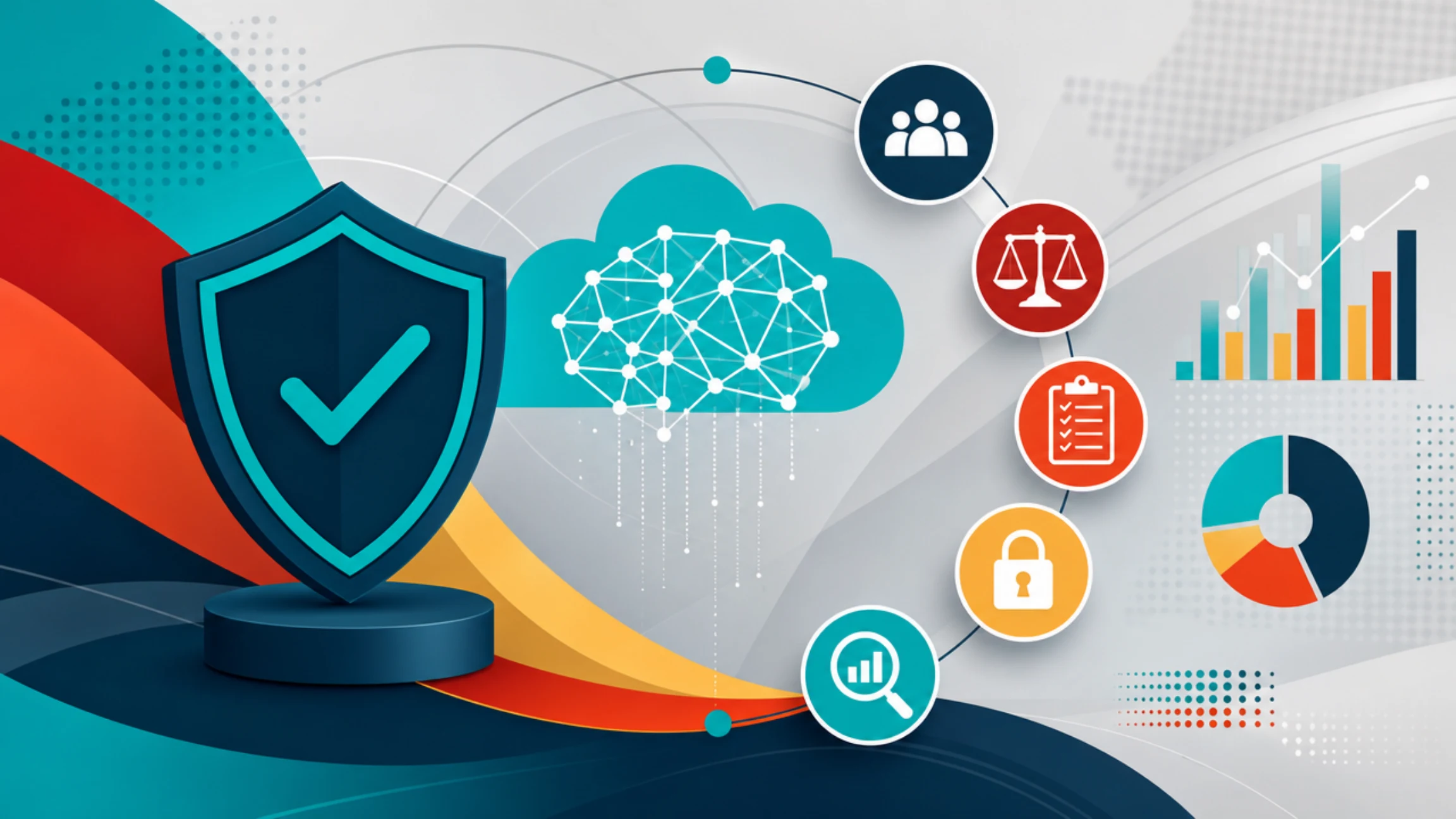
Every time AI within Salesforce touches your data, controls must run in the background to keep your customers’ information private, block bad actors from manipulating the system, and record what happened. The Einstein Trust Layer automatically handles all of that work for every AI interaction.
Here’s what the Trust Layer delivers in business terms:
- Your customer data stays private. Personally identifiable information is redacted before prompts leave Salesforce for an external model, and restored before results are returned to your users. Nothing sensitive ever sits in a third-party model’s memory.
- Your sharing rules still apply. AI can only see data that the requesting user is already permitted to see. Your existing Salesforce permissions govern what AI can reference automatically.
- Your prompts don’t train somebody else’s model. Partner model providers in Salesforce’s Shared Trust Boundary, including OpenAI, contractually agree not to retain your prompts or outputs for their own training. Anthropic goes one step further: Claude models hosted on Amazon Bedrock run inside the Salesforce Trust Boundary itself, with traffic that never leaves Salesforce’s virtual private cloud.
- Bad inputs get blocked. Prompt defense hardens AI against manipulation attempts where attackers hide instructions inside ordinary content. Toxicity detection blocks harmful outputs before they reach a user.
- Every interaction leaves a paper trail. Your compliance team gets a complete audit log of what went in, what came out, and what happened in between. That’s evidence you can hand to regulators, auditors, or your own board.
For regulated industries, much of what compliance teams used to build from scratch is now native to the platform. That changes the economics of AI deployment more than most leaders expect.
Data 360: The Trusted Foundation Beneath Your AI
AI outputs are only as trustworthy as the data beneath them. Data 360 (formerly Data Cloud, renamed in October 2025) is Salesforce’s unified data foundation, and, under Agentforce 360, it’s the grounding layer that every AI agent reasons against.
Two recent additions make Data 360 especially valuable for AI governance:
- Intelligent Context brings your unstructured content into scope. PDFs, reports, emails, and diagrams become information your agents can leverage, alongside the structured records they already use.
- Tableau Semantics gives your AI a single, consistent definition of your business language. When “revenue,” “active customer,” or “at-risk account” mean the same thing across every cloud, your agents stop contradicting each other.
Beneath those additions, Data 360 does the quiet work that matters. For example:
- It unifies customer profiles across disparate systems.
- It carries consent signals so AI respects what each customer opted into.
- It applies classification labels so sensitive fields get handled appropriately.
- And it supports Zero Copy integration with Snowflake, Databricks, BigQuery, and Redshift, so AI can reason over your enterprise data without creating duplicate copies.
Govern Data 360 well, and Agentforce operates on a foundation your company can defend to anyone who asks.
Agentforce: Governance for the Agents Taking Action on Your Business
Agentforce is Salesforce’s platform for deploying AI agents. What makes agents different from earlier Salesforce AI capabilities is that they take action. They update records, trigger flows, reach into external systems, and coordinate across applications on your company’s behalf.
The Atlas Reasoning Engine, Salesforce’s proprietary framework, lets agents plan and execute multi-step work.
With earlier Salesforce AI features, the main governance-related question was “What did the AI say?” With agents, it becomes something sharper: “What did the agent do, under whose authority, with what data and evidence?”
Agentforce answers that question by design. For every agent your company deploys, Salesforce gives you a governance configuration that defines:
- What the agent can talk about, and what it must escalate or decline
- Which actions it can take on which systems, and under what conditions
- Which data it can reference when it reasons
- When a human reviewer must step in
- Which model runs behind it: Salesforce’s default models (GPT-4o today), AWS-hosted Anthropic Claude Sonnet 4, or your own choice from Google Gemini, Meta LLaMA, Mistral, and others.
A newer Agentforce 360 capability called Hybrid Reasoning, combined with Agent Script, lets your teams decide where an agent should use LLM creativity and where it must follow strict business logic. That matters because regulated industries often need deterministic behavior on high-stakes decisions, with LLM flexibility reserved for everything else.
The pre-built agent library has grown quickly. Salesforce now offers pre-built agents across customer-facing teams, employee operations, and industry-specific workflows, including:
- Agentforce Service. Conversational AI that resolves customer service cases across self-service portals and messaging channels, with seamless handoff to human agents for complex issues.
- Agentforce Sales. A six-agent suite launched March 16, 2026, that handles lead qualification, sales coaching, pipeline analysis, and other stages across the sales lifecycle.
- Agentforce Commerce. Conversational guided shopping, checkout support, and personalized recommendations across both B2C and B2B commerce experiences.
- Agentforce Marketing. Campaign brief drafting, multi-channel journey generation, and autonomous optimization of marketing campaigns as they run.
- Agentforce IT Service. Autonomous resolution of IT tickets inside Slack, Microsoft Teams, or an employee portal, without forcing employees to file through a separate helpdesk system.
- Agentforce HR Service. Employee-facing answers and process execution for HR questions, from benefits and leave policies to onboarding and internal transfers.
- Agentforce Voice. A native voice layer that runs inside contact center platforms including Amazon Connect, Five9, Genesys, NiCE, and Vonage, with every interaction logged back into Data 360 for audit.
- Agentforce Contact Center. A fully native contact center-as-a-service (CCaaS) platform that integrates voice, digital channels, CRM data, and AI agents into a single system, released in March 2026. For companies already running Salesforce Service, this closes the gap between CRM and contact center without another integration layer.
- Agentforce 360 for Industries. Pre-built, industry-specific agents for regulated verticals, including Agentforce Life Sciences, Agentforce Public Sector, Agentforce Manufacturing, Agentforce Financial Services, and Agentforce Healthcare.
Salesforce maintains a growing catalog of pre-built agent use cases at salesforce.com/agentforce/pre-built-use-cases. In an upcoming Summit article, we’ll dive deeper into how to choose, govern, and operationalize them for your specific business.
With Salesforce, your company has a growing library of AI workers, each with its own guardrails, logged, and answerable.
Salesforce Shield: Evidence for the Regulators
For companies in regulated industries, Salesforce Shield is where AI governance meets the evidence that regulators, auditors, and board members need to see.
Shield adds four reinforcements on top of the standard platform:
- Platform Encryption strong enough for HIPAA, PCI DSS, and the most sensitive data your company holds, now extended to Data 360, which means the data grounding your Agentforce agents can be protected with your company’s own encryption keys.
- Event Monitoring across more than 50 event types, so your security team sees who did what across the platform.
- Field Audit Trail, which preserves field-level change history for up to ten years and, as of Spring ‘26, tracks up to 200 fields per object. For financial services and healthcare, this is usually what regulators demand.
- Data Detect automatically scans PII across your org, so you know where your sensitive data actually lives before AI starts touching it.
The Spring ‘26 release brought all four into a single unified Shield Experience, so your team configures them in one place instead of four. That’s a meaningful reduction in the expertise required to run them well.
If your company operates under GDPR, HIPAA, SOX, PCI DSS, or anything similar, Shield is how you prove your AI program is defensible.
Prompt Builder and Model Builder: Control Over How AI Behaves
Two more capabilities deserve attention because they determine how much control your company has over AI behavior.
- Prompt Builder is where your company designs the instructions that shape what AI says. Every Agentforce agent and every embedded Einstein feature (the sales email drafter, the service reply generator, the meeting summarizer) runs on a template your team can customize. The templates are grounded in your actual CRM data, which is what keeps AI output specific to your business rather than generic. Running Prompt Builder well is less about the tool itself and more about the discipline around it: who can change a template, who approves it, and how you catch a problem before it reaches a customer. Summit helps clients build that discipline.
- Model Builder, which lives inside Einstein Studio, is where your company chooses which AI models it actually trusts. Three paths are available:
- Use Salesforce’s managed models, which are the right answer for most organizations.
- Bring your own model through four pre-built connectors for OpenAI, Azure OpenAI, Google Gemini, and Anthropic Claude on Amazon Bedrock.
- Or, for specialized needs, use the LLM Open Connector to plug in any model built against the OpenAI-style chat completions API, including Mistral, Meta LLaMA, Cohere, IBM Granite, Databricks DBRX, or your own in-house model.
Whichever path your company takes, every request routes through the LLM Gateway and the Einstein Trust Layer. Your governance controls apply no matter what model sits behind the curtain.
Salesforce gives you the controls. A governance program is what turns controls into outcomes.
Where Salesforce Customers Often Get Stuck
Having the capabilities isn’t the same as operating them well. Three patterns show up repeatedly in many Salesforce customer organizations:
- The Trust Layer is on but not tuned. Turning it on is the first step. Tuning its rules to your actual data sensitivity, configuring it against the attack patterns relevant to your industry, and reviewing the audit trail it produces is critical work. Most companies stop at step one.
- Data 360 is deployed but not governed to AI standards. Gaps in consent, classification, or lineage that were tolerable for analytics and reporting become material the moment AI agents start drawing on that data. AI raises the governance bar, and most Data 360 implementations were built before that bar moved.
- Agent portfolios grow without coordination. One agent gets deployed well. A second goes in with slightly different guardrails. A third uses different grounding sources. Six months later, the company has a portfolio of agents with inconsistent governance, and nobody is tracking how it’s drifting.
The common thread: capabilities enabled, program absent. Closing that gap is where experienced partners earn their value.

How Summit Helps
Summit is a Summit-Tier Salesforce Consulting Partner. We’ve delivered over 1,300 Salesforce projects, and our team holds over 70 Salesforce certifications and counting. We help organizations turn the Salesforce AI capabilities they already own into a working program for scalable, safe, and responsible AI through our Salesforce AI Advisory Services.
Most of our Salesforce AI engagements start in one of three places:
- Salesforce Health Check. A structured look at your current Salesforce environment, including how ready it is for Agentforce and where governance gaps would block safe AI expansion.
- Data Health Check Assessment. A focused engagement examining your data foundations, ownership, controls, and policies across what matters for AI in production.
- Agentforce QuickStart. A governed deployment of Agentforce that lands in weeks, with the Trust Layer, Data 360 grounding, and agent guardrails configured deliberately for your specific use case.
From there, engagements typically expand into broader AI Data Governance services, including design, Data 360 governance raised to AI standards, and the cross-functional operating model that keeps a growing portfolio of agents coordinated as it scales.
For the broader strategic framing of AI data governance, see our companion article: “AI Data Governance: What Business Leaders Need to Know Before Scaling AI.”
The Bottom Line
Salesforce has done something genuinely valuable for its customers. The Einstein Trust Layer, Data 360, Agentforce governance, Salesforce Shield, Prompt Builder, and Model Builder together form a set of capabilities that would have taken most companies years to build.
Your company already owns most of that foundation. The work ahead is activating it deliberately: turning platform controls into a working program, building ownership across business and IT, and treating governance as a daily practice rather than a setup task that ends at go-live.
The Salesforce customers who will win with AI over the next three years are the ones who start this work now, while their AI programs are still small enough to shape.
Summit helps Salesforce customers make that shift through our Salesforce AI Advisory Services. Our team has operationalized AI across healthcare, financial services, public sector, higher education, and commerce. Let’s talk — before your AI program outgrows the governance around it.
Key Takeaways
- Salesforce launched Agentforce 360 at Dreamforce 2025. Its four components are the Agentforce 360 Platform, Data 360 (formerly Data Cloud), Customer 360 Apps, and Slack. Together, they consolidate AI across every Salesforce cloud into a single system.
- The Einstein Trust Layer gives your company a safety net on every AI interaction: data masking, sharing-rule enforcement, zero data retention with partner LLMs, toxicity detection, and a complete audit trail stored in Data 360.
- Data 360 is the trusted foundation beneath Agentforce. Intelligent Context extends AI to your unstructured content. Tableau Semantics keeps your business language consistent across every cloud.
- Agentforce, powered by the Atlas Reasoning Engine, lets your company deploy AI agents that take real action on the business. Each agent carries its own governance configuration. The pre-built library now includes Agentforce Sales (launched March 16, 2026), Service, Commerce, Marketing, Voice, and a growing set of industry agents, as well as the new Agentforce Contact Center.
- Salesforce Shield extends Platform Encryption to Data 360 and now tracks up to 200 fields per object in Field Audit Trail (Spring ‘26), giving regulated organizations the evidence trail that auditors and regulators want to see.
- Most Salesforce customers are underusing what they already own. The capabilities are built. The value lies in operating them as a program, where a specialized partner like Summit delivers the most leverage.
Frequently Asked Questions About AI Governance in Salesforce
What does AI governance in Salesforce include?
AI governance in Salesforce covers the built-in platform capabilities that protect your data, shape AI behavior, and provide your compliance team with defensible evidence. That includes the Einstein Trust Layer, Data 360 governance, Agentforce guardrails, Salesforce Shield, Prompt Builder, and Model Builder. Together, these protect your customers’ information, enforce your company’s rules, and log every AI interaction for review.