Bringing Einstein, Agentforce, Data 360, and the Trust Layer Together
Salesforce AI is no longer a single feature or assistant. It is a connected stack of predictive AI, generative AI, autonomous agents, trusted data, and governance controls built into the Salesforce platform. This article explains how Einstein, Agentforce, Data 360, Prompt Builder, and the Einstein Trust Layer work together, why the data foundation matters, and how leaders should approach the sequencing of Salesforce AI adoption.
Introduction: Salesforce AI has become a connected stack
Salesforce AI began as a predictive capability for scoring leads, forecasting sales, and flagging customers at risk of leaving. It has since grown into a connected stack: Einstein, Agentforce, Data 360, Prompt Builder, and the Einstein Trust Layer that ties them together.
For most leaders, the decision to adopt AI inside Salesforce is already settled. What takes more judgment is choosing which capabilities to sequence, which workflows are ready, and whether the underlying data can support the results the business expects.
The parts that get the most attention are rarely the parts that decide whether the program succeeds. A polished AI assistant or agent can only be as reliable as the data, permissions, grounding, governance, and operating model underneath it.
This article explains what each layer does, how the pieces connect, and why Salesforce AI works best when the foundation beneath it is treated as part of the strategy, not a technical afterthought.
What is Salesforce AI?
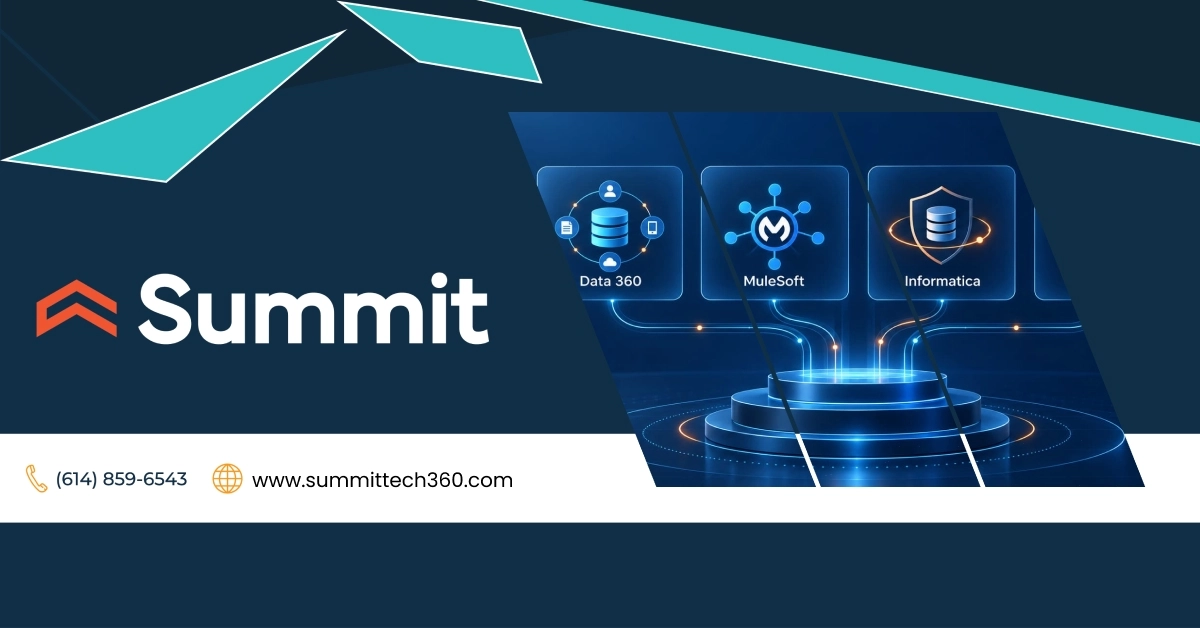
Salesforce AI is the set of artificial intelligence tools built into the Salesforce platform: predictive and generative features under the Einstein brand, autonomous agents through Agentforce, the Data 360 (formerly Data Cloud) data foundation that feeds them, and the Einstein Trust Layer that governs how they handle data.
For organizations already running Salesforce, much of this is within reach today, and some of it is active by default. The advantage goes to the teams that understand how the layers relate before they commit to any one of them.
Salesforce now unifies these tools under a single platform, Agentforce 360, and continues to embed AI across every cloud. For most Salesforce customers, AI is already operating on their data, often the most regulated and sensitive data they hold. The task now is to understand the stack well enough to direct it with intent rather than absorb it by default.
As part of our Salesforce AI advisory services, we help organizations map this stack to their own systems and data.
What follows is the version every Salesforce customer starts from.
What does Salesforce AI include?
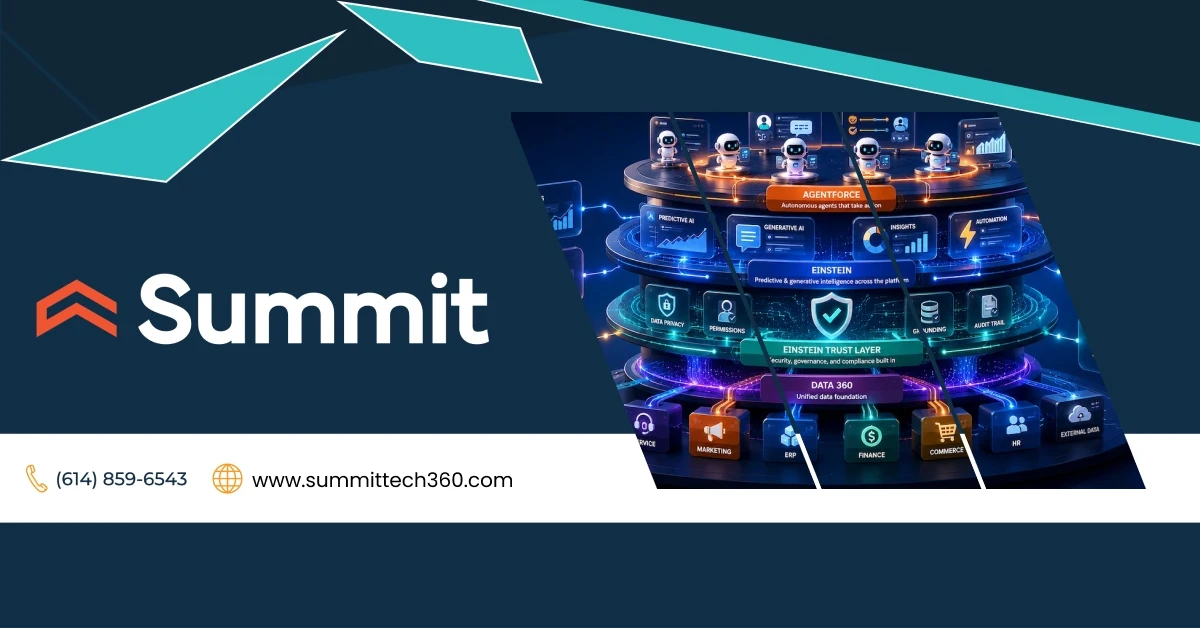
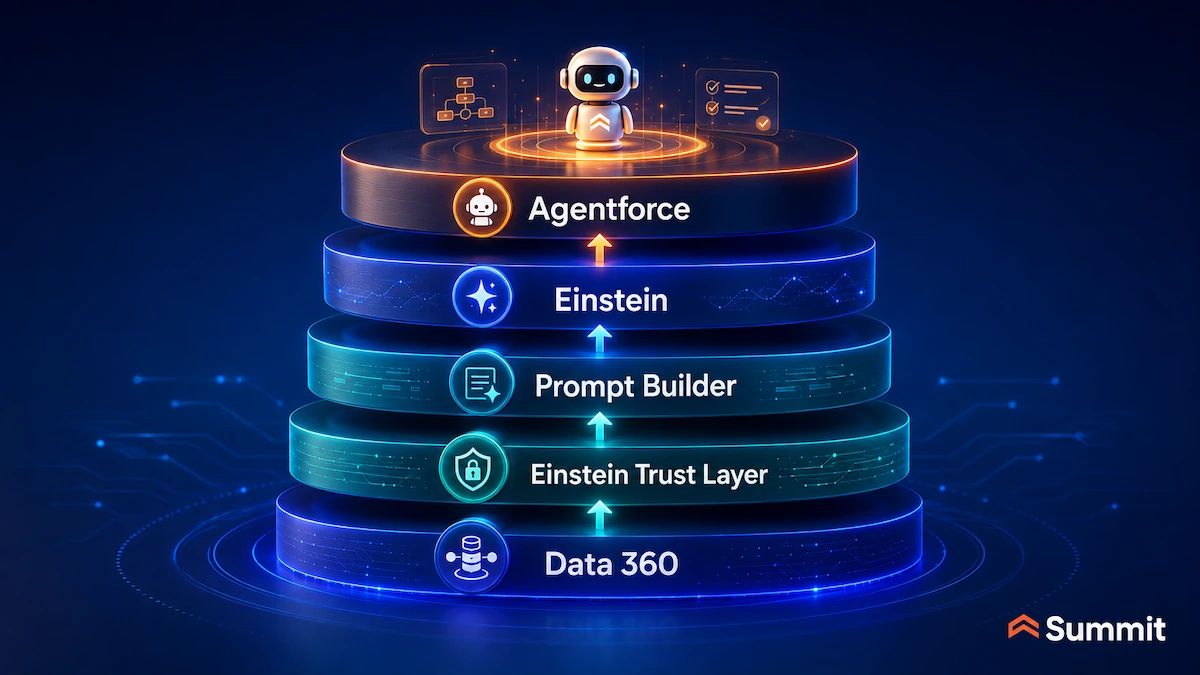
The platform's AI is organized in layers, each handling a different job, from the data underneath to the agent on top.
| Layer | What It Is | What It Does |
|---|---|---|
| Einstein | Salesforce’s core AI brand | Predictive scoring and forecasting, plus generative features like summaries and drafted replies across the clouds. |
| Agentforce | The platform for autonomous AI agents | Carries out multi-step tasks within the guardrails you set. |
| Prompt Builder | A prompt-building tool | Creates reusable, data-grounded prompt templates teams can trust. |
| Einstein Trust Layer | The security and governance layer | Enforces user permissions, blocks providers from retaining your data, screens outputs, and logs activity. |
| Data 360 | The unified data foundation | Brings data together so AI answers with current, complete context. |
Read top to bottom, those rows are a feature list. Read bottom to top, they are a dependency chain. We will present them in the order a buyer typically encounters them, then show why the bottom of the table matters most.
What is Salesforce Einstein?
Einstein is the part that most teams meet first because much of it is already on. It does two jobs. Predictive Einstein scores leads and opportunities, forecasts outcomes, and surfaces the records that need attention. Generative Einstein drafts replies, summarizes cases and records, and answers questions in plain language.
These features live inside the clouds your people already work in, so a seller sees Einstein in Sales Cloud and a service rep sees it in Service Cloud. For many organizations, Einstein is the on-ramp. It earns trust in the platform before anyone commits to building agents.
Einstein is where most organizations learn to trust Salesforce AI before they hand it real autonomy.
What is Agentforce?
Agentforce is where Salesforce AI stops giving advice and starts doing the work. An Einstein feature helps a person in the moment. An Agentforce agent takes a task and carries it through several steps on its own, inside the guardrails you set, then hands back to a human when it reaches a limit you defined.
This is also the layer that changed most recently, so the names can be confusing. The assistant Salesforce once called Einstein Copilot is now part of Agentforce, and the agents reason over your CRM data and knowledge rather than the open internet. Which task an agent should take on first deserves its own discussion, and we work through it by team in Agentforce use cases by department.
When an organization is ready to put one into production, Summit's Agentforce QuickStart gets a first agent live on a defined scope.
An agent is only as trustworthy as the limits you set and the data it is allowed to access.
For more detailed information on Agentforce, view our blog post, What is Agentforce?
What is Data 360, and why does AI need it?
Data 360, formerly Data Cloud, is the foundation the rest of the stack stands on. It unifies information from across your systems into a single, up-to-date view, so that when an agent or an Einstein feature answers, it answers from the whole picture rather than a fragment.
This is where the dependency chain pays off, and it is easier to see in a story than in a definition.
AI inherits the quality of the data beneath it.
Strong data does not guarantee strong AI, but weak data guarantees weak AI, only faster and at greater scale. That is why teams ask whether Agentforce needs Data 360 before they launch, and why we treat the data layer as a first-order decision in What is Salesforce Data Cloud (Data 360), distinct from the older Customer 360 idea it builds on.
How does Salesforce keep AI data secure?
The Einstein Trust Layer sits between your data and the AI models, and it is the reason organizations in regulated industries and the public sector can put Salesforce AI to work at all. It helps keep AI interactions aligned with user permissions, data-handling rules, approved model access, response screening, sensitive-data protections for supported generative workflows, and audit logging.
The detail matters to a security or compliance lead. Salesforce supports a range of large language models, from providers including OpenAI, Anthropic, and Google. Some run inside Salesforce’s own trust boundary, and others are external models held to the same zero-retention standards.
Because packaging and availability can vary by edition and product, leaders should confirm which AI, Agentforce, and Trust Layer capabilities are available in their Salesforce environment before planning a rollout.
We walk through where it fits among the broader controls in AI governance in Salesforce.
In a regulated environment, this layer is what separates a defensible AI decision from an indefensible one.
How do the pieces work together?
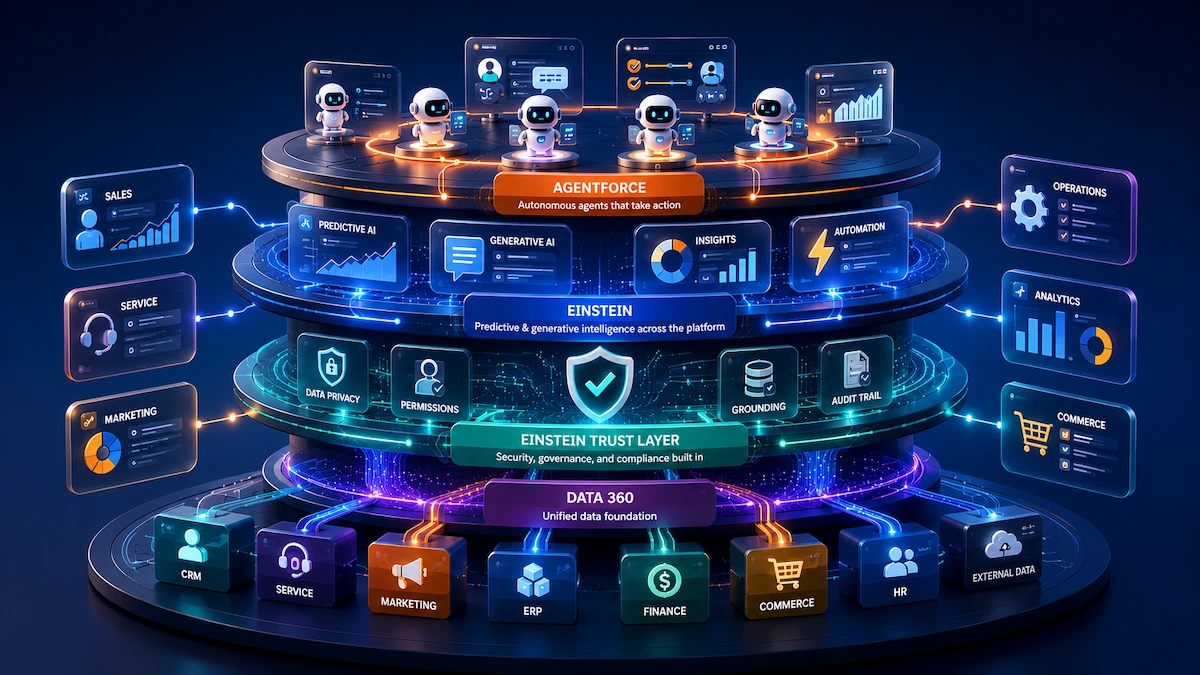
Put the layers in sequence, and the platform makes sense. Data 360 unifies the data. The Einstein Trust Layer governs how that data reaches a model and what comes back. Einstein and Agentforce turn it into predictions, content, and action inside the tools your team already uses. Salesforce packages all of this under a single banner, but the order of the layers determines whether it delivers.
The order is the point. Capability at the top of the stack is only as trustworthy as the data and governance at the bottom. A polished agent on a shaky data foundation is a confident wrong answer waiting to happen, which is why a Salesforce AI program that holds up tends to get built from the bottom up.
How Summit helps
Summit is a Summit-Tier Salesforce Consulting Partner. We’ve delivered over 1,300 Salesforce projects, and our team holds over 70 Salesforce certifications and counting. We help organizations turn the Salesforce AI capabilities they already own into a working program for scalable, safe, and responsible AI through our Salesforce AI Advisory Services. We work with enterprise and public-sector organizations, many of them in regulated industries like financial services, healthcare, higher education, and government, where an AI decision has to be explainable and defensible.
Most of our Salesforce AI engagements start in one of three places:
- Salesforce Health Check. A structured look at your current Salesforce environment, including how ready it is for Agentforce and where governance gaps would block safe AI expansion.
- Data Health Check Assessment. A focused engagement examining your data foundations, ownership, controls, and policies across what matters for AI in production.
- Agentforce QuickStart. A governed deployment of Agentforce that lands in weeks, with the Trust Layer, Data 360 grounding, and agent guardrails configured deliberately for your specific use case.
From there, engagements typically expand into broader AI Data Governance services, including design, Data 360 governance raised to AI standards, and the cross-functional operating model that keeps a growing portfolio of agents coordinated as it scales.
For the broader strategic framing of AI data governance, see our companion article: “AI Data Governance: What Business Leaders Need to Know Before Scaling AI.”
We apply our VECTOR framework to Salesforce AI implementations to ensure your AI is working with data that’s trusted. Learn more about the VECTOR framework here.
A focused conversation can show you where Salesforce AI will pay off first, and where your data is not yet ready to support it. Let's talk to get you started on the right path quickly with Salesforce AI.
The bottom line
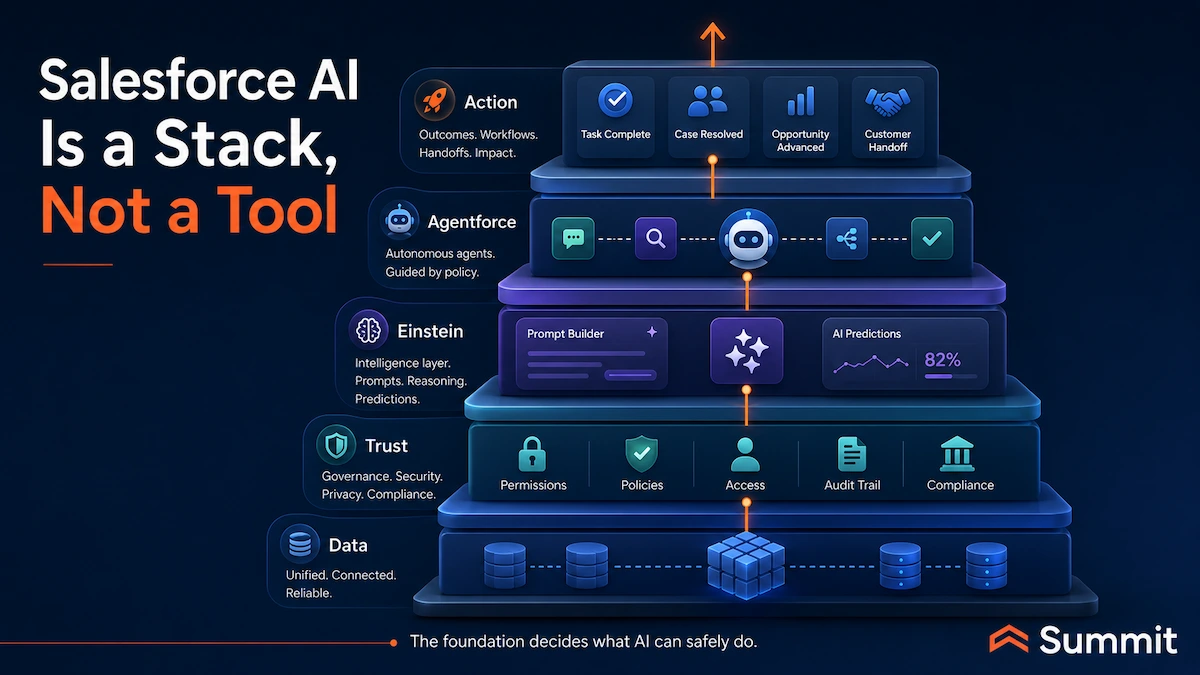
Salesforce AI is best understood as a stack, not a single tool. Einstein helps users predict, summarize, generate, and act inside the flow of work. Agentforce gives AI more autonomy to complete defined tasks. Data 360 gives those capabilities broader, more current context. The Einstein Trust Layer helps govern how data is used and how AI responses are produced.
The strategic decision is not whether Salesforce has AI. It does. The better question is whether your data, workflows, permissions, guardrails, and operating model are ready for the AI capabilities already arriving inside the platform.
Start with the foundation. Then choose the use cases that are narrow enough to govern, meaningful enough to measure, and valuable enough to earn trust.
Key takeaways
- Salesforce AI is a connected stack: Einstein for predictive and generative features, Agentforce for autonomous agents, Data 360 for the data foundation, and the Einstein Trust Layer for security.
- Einstein assists a person in the moment; an Agentforce agent completes multi-step work within set guardrails. Einstein Copilot is now part of Agentforce.
- The Einstein Trust Layer and Prompt Builder come with Salesforce's generative AI tools, not as separate add-ons.
- Data 360 is the layer that decides whether the rest performs. Weak data produces confident, scaled mistakes.
- A Salesforce AI program that holds up in production, and in front of an auditor, is built from the data foundation up rather than the demo down.
Frequently Asked Questions About Salesforce AI
Is Salesforce AI included with Salesforce?
Some Einstein features are available based on your edition, while capabilities like Agentforce and Data 360 are provisioned separately. Availability depends on your edition and licensing, so the right starting point is confirming what your org already has access to.