Most companies evaluating Agentforce will build something promising in a test environment. Far fewer will get it running with real customers and real data. This guide explains why that gap exists and how the Salesforce Agentforce Quickstart closes it.
What is the Salesforce Agentforce Quickstart?
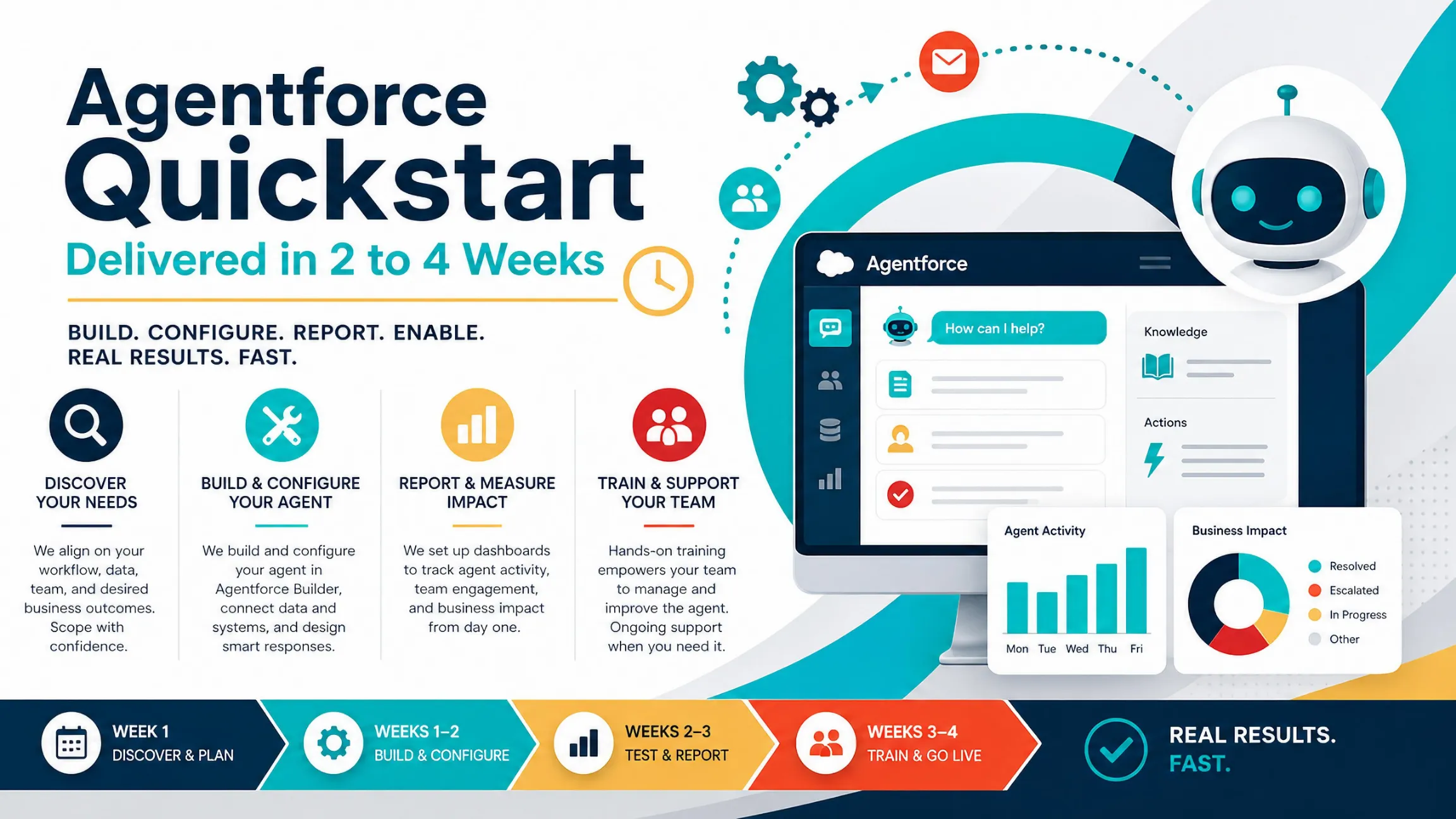
The Salesforce Agentforce Quickstart is a packaged, two- to four-week engagement that helps a company launch its first AI agent on the Agentforce 360 platform. Summit works with you to choose the right first workflow for the agent to handle, builds the agent against your trusted Salesforce data, sets up Agentforce reporting so you can see how it’s performing, and trains your team to manage the agent after launch.
Why a Focused First Agentforce Deployment Matters
Most Agentforce evaluations start the same way. Leadership greenlights an AI agent exploration. The technical team builds something promising in a test environment: an agent that handles common support questions, qualifies new sales leads, or pulls together a customer history on demand. The demo goes well. The roadmap reflects the win.
Then the questions that nobody answered up front start to surface. Which workflow do we actually launch the agent on? Whose data does it run on? Who owns it after launch? How will we know if it’s working?
Six months later, that promising demo is still a demo. The executive sponsor has moved to another initiative. Someone in the room asks quietly whether this agent will ever launch.
Across mid-market and enterprise Agentforce evaluations, Summit sees the same pattern: most Agentforce deployments stall before the agent gets built. The technology isn't usually the barrier. Agentforce works, and Salesforce's own reference customers prove it at scale. What stalls deployments is the work that wasn't done up front — choosing the right workflow for the agent, and getting the underlying data ready to support what the agent will do.
An AI agent is only as good as the data behind it and the discipline that focuses it.
A focused first deployment is the antidote.
The right approach focuses on one valuable workflow for the agent to handle, builds the agent on data your team already trusts, and sets up Agentforce reporting so leadership can see how the agent is performing from day one. That first agent becomes the foundation for the second, the third, and the broader rollout that follows.
Getting it right is the work that determines whether the rest happens at all.
What Makes an Agentforce Quickstart Work
Summit’s Agentforce Quickstart is built around the real-world challenges of launching a first AI agent, not the technical novelty of the underlying AI. Our approach centers on three core disciplines.
Picking the right first workflow with you
Most teams approach a Quickstart engagement with two or three ideas already in mind for what the agent should handle first. Our first conversation is usually about narrowing, not expanding. The strongest first agents are wrapped around one workflow that meets three tests at once: focused enough that the agent can perform well at it, valuable enough that leadership can defend the investment, and visible enough that you can tell from day one whether it’s working.
Common starting points include support case routing, sales lead handoff, and data entry on routine records. These aren’t the most exciting jobs, but they’re the ones that consistently meet all three tests.
Building the agent around how your work actually happens
Most recurring workflows in your business follow a common set of steps. Someone submits something. It gets routed. A person picks it up, looks up history, asks for more information, drafts a response. Each step is a decision point where an agent could help…or get in the way.
Designing the agent well means mapping those steps.
- What should set the agent into motion?
- What actions is it allowed to take?
- What information does it need to do its job?
- Where does it hand off to a person when something falls outside what it should handle on its own?
- When the workflow calls for it, should the agent pull information from elsewhere in Salesforce, or from outside systems through standard integrations?
We sort out what your agent actually needs, and what can wait for a later phase, before we start building. That conversation isn’t just a technical one. It’s an operational one too. And it’s the conversation that decides whether the agent feels useful to your team or feels like overhead.
Setting up measurement and ownership from day one
Two things have to be in place when we hand the agent off: visibility and ownership.
- Visibility means agent activity, conversation volume, escalations to humans, and outcomes flowing into dashboards your leadership actually uses. We set up Agentforce reporting during the Agentforce Quickstart engagement, so the data is there from launch, and the post-launch conversation is about evidence rather than promises.
- Ownership means that the team running the workflow also owns the agent. By the time the engagement ends, your internal team has the skills to adjust the agent, expand its scope, and improve its performance without having to call us back for every tweak.
We offer hands-on Salesforce training during delivery to make sure that handoff to admins and teams is effective. The Quickstart is a packaged engagement. The agent’s life inside your business isn’t.
What a Focused First Agentforce Deployment Can Unlock
Salesforce’s Agentforce 360 announcement features several reference customers whose results demonstrate what a focused first Agentforce deployment can achieve when the workflow, data, and team are aligned. Three of those stories are worth looking at closely, because each one tells a different lesson.
Reddit: Agentforce for Customer Support
After launching its first Agentforce agent for customer support, Reddit handled 46% of support cases without a human touching them and cut resolution time by 84%, bringing average response time down from 8.9 minutes to 1.4 minutes. The agent handles routine, high-volume questions that don’t require human judgment, freeing the team to focus on the harder advertiser issues that do.
This is the easiest pattern to point at: the cleanest first job for an agent to handle in a customer service operation, and the one most likely to produce a measurable result inside a Quickstart window.
Absa Relationship Banking: Agentforce for Financial Services
According to the Salesforce customer story for Absa, Absa Relationship Banking expects Agentforce to resolve charge disputes 88% faster while handling 50% of fraud cases. CIO Lindelani Ramukumba, in the Agentforce for Financial Services announcement, described it this way: “Agentforce empowers our service team to resolve pressing customer issues 88% faster, while significantly speeding up fraud management through 24/7 agentic support.”
Absa built the deployment on Salesforce’s Data 360, a tool that unifies customer information from across the bank into one trusted view, and the Einstein Trust Layer, Salesforce’s compliance and safety layer for AI. Both are foundational pieces, and Absa put them in place before the agent went anywhere near a customer.
The data and compliance foundation got built first. Most regulated industries underestimate how much of that work has to be done before AI can actually deliver, and Absa did it the right way around.
Adecco: Agentforce for Candidate Engagement
Salesforce reports that Adecco handled 51% of candidate conversations outside of standard working hours through Agentforce. For a global staffing firm, that means faster responses to candidates, better placement velocity, and a more consistent candidate experience without growing the human team. What’s interesting about Adecco is the kind of work the agent does. After-hours candidate engagement was a capacity gap humans couldn’t cover at scale. The agent fills the gap rather than replacing people who were already filling it.
While the headline numbers and lessons differ, the underlying pattern is the same. Each deployment started with a workflow the team could explain in a sentence. Each ran on a trusted data foundation that was prepared for the task the agent was asked to perform. Each launched with measurement in place so leadership could see results from day one.
Focused workflow. Trusted data. Measurement from day one.
This is the pattern our Agentforce Quickstart is designed to produce.
Inside the Agentforce Quickstart: What We Deliver in 2 to 4 Weeks
Every Summit Agentforce Quickstart engagement is tailored to the workflow, data, and team. The core deliverables stay the same, and in most cases, everything lands within a two- to four-week window. The full configuration summary lives on our AI (Agentforce) Quickstart service page.
Business needs discovery
We start with working sessions focused on the workflow you want the agent to handle, the people the agent will support, the business outcome you’re after, and the data the agent will need. Discovery is where the scope gets locked in. It’s also where most of the risk of a first deployment gets retired, before any building starts.
Building and configuring the agent in Agentforce Builder
Our Salesforce-certified consultants build your agent in Agentforce Builder, Salesforce's tool for designing and configuring agents. We design the agent to respond to specific triggers, such as inbound emails, sales activities, or events within a workflow. When the workflow calls for it, the agent can pull information from elsewhere in Salesforce or from outside systems through standard integrations.
Setting up Agentforce reporting
We set up Agentforce reporting during the build, so your leadership has dashboards to track agent activity, team engagement, and business impact from day one.
- Which agents are most active
- Which teams are using them
- Where the agent is helping
- Where it needs adjustment
The data is there when you need it.
Training your team and ongoing support
Hands-on Salesforce training and enablement are part of every Quickstart, so your internal team has what it needs to manage and improve the agent after we hand off. Ongoing support is available when you want it, designed to be there without being intrusive.
A note on timelines
The two- to four-week timeline depends on your workflow complexity and data readiness. A focused first workflow running against accessible Salesforce data usually lands near the two-week mark. A workflow that requires integrating data from external systems or unifying customer data across multiple sources usually takes closer to four weeks.
How the Agentforce Quickstart Compares to Other Deployment Paths
There are four common paths to a first Agentforce agent: build the agent yourself with your own team; hire a general Salesforce consulting firm; run an extended pilot that proves the concept before committing to a launch; or leverage a Quickstart program with a Salesforce partner who’s built first agents before. Each path fits a different situation, and the trade-offs become clear once you compare them directly.
Agentforce Quickstart vs. building it yourself
The argument for building it yourself is real. Your team owns every decision and carries the expertise forward. The argument against is that Agentforce is new for everyone, including your team. Your people are learning the platform and the workflow at the same time. That double learning curve is where most do-it-yourself first agents stall.
The Quickstart trades full ownership for faster time-to-launch and Salesforce-certified expertise from the start.
Agentforce Quickstart vs. a broader Salesforce consulting engagement
A Salesforce consulting firm can often deliver an Agentforce build. But scope, timeline, and cost may require negotiation every time, and the depth of Agentforce experience varies firm to firm.
The Summit Agentforce Quickstart is packaged with a known scope, known deliverables, and a known timeline, and run by experts who’ve done it before. The trade-off is flexibility. If your first deployment is genuinely unusual and won’t fit a packaged engagement, a custom engagement may be the right choice.
Agentforce Quickstart vs. running an extended pilot
Pilots are great for proving a concept. They’re often poor at proving operational reality: data quality, handoffs to humans, reporting, and your team’s ability to own the agent after launch. A pilot that lives in a test environment for six months tells you less about whether Agentforce will work for your business than a Quickstart that puts a working agent in front of real users and real data inside two to four weeks.
The Quickstart fits best when your goal is a working first agent in your business, on a defined timeline, with the discipline and reporting in place to grow from there.

Who Benefits Most from an Agentforce Quickstart?
We’ve built our Quickstart packages around six core kinds of functional teams. Each one tends to anchor on a different Agentforce agent as the right first step.
Customer service teams → Agentforce Service Agent
Service leaders come to us with a familiar problem. Case volume is rising. Response times are slipping. Reps are spending most of their day on routine questions that don’t require their judgment.
The first Agentforce agent for this kind of team is almost always Salesforce’s Agentforce Service Agent, configured against the case types, routing rules, and escalation paths your team uses today. Reddit’s pattern (46% of support cases handled without a human, resolution time cut by 84%) is the kind of outcome this profile most often works toward.
What you get from Summit on a service engagement is the expertise of our team members who have built case-handling automation many times before. Our Salesforce-certified consultants, with customer service platform experience, lead the working sessions from day one.
The early conversations are about your operations and needs, not just the technology: which cases your reps actually want to keep, which ones they’d happily hand off, and where the line between agent and human falls in your specific service operation.
Sales teams → Agentforce SDR Agent and Sales Coach Agent
Sales leaders typically seek outcomes like better follow-through on inbound leads and more effective coaching for sellers.
Salesforce’s Agentforce SDR Agent and Agentforce Sales Coach Agent map directly to those two outcomes. The SDR Agent works inbound leads 24/7, qualifies them, handles common objections, and books meetings without waiting on a human to clear the queue. The Sales Coach Agent runs deal-specific role-plays with sellers and gives them personalized feedback they can use before their next conversation.
The Summit team behind an Agentforce sales engagement has spent years inside Salesforce sales implementations of every size. We know what makes lead qualification consistent. We know what makes sellers actually log activities. And we know, from watching a lot of failed adoption cycles, where AI in the sales stack slows reps down instead of speeding them up.
Our opening conversations focus on how your reps work today: what they ignore, what they trust, and what they’ll actually use.
Marketing teams → Agentforce Campaign Optimizer and Journey Agent
Marketing leaders feel significant pressure to deliver more personalized campaigns and customer experiences at a greater scale, with the same team and budget they had last year.
The Agentforce Campaign Optimizer and Agentforce Journey Agent are designed for that gap. Both use unified data to plan, test, and improve campaigns in real time, and to shape customer experiences that improve conversion with every interaction.
Which one becomes your first agent depends on where the squeeze is sharpest. Teams stuck in campaign-execution overload usually start with the Campaign Optimizer. Teams managing complex customer experiences across product, support, and renewal often start with the Journey Agent. We map the right starting point against your campaign tools, customer journey complexity, and data foundation during discovery, usually inside the first working session.
Financial services teams → Agentforce for Financial Services
Banks, credit unions, insurance firms, and wealth managers face challenges the rest of the market doesn’t share. Advisor capacity is shrinking. Client expectations are rising. And compliance overhead doesn’t flex to accommodate either trend.
Salesforce’s Agentforce for Financial Services is built for that pressure. It includes a Banking Service Agent, a Financial Advisor Agent, a Banker Agent, and a Digital Loan Officer Agent, each configured against your compliance environment and your data.
Absa Relationship Banking shows what’s possible inside those constraints. Charge disputes resolved 88% faster. Fraud cases handled at scale. 24/7 service across 15 African countries, all without breaking the compliance posture that makes the banking license viable.
We work through the compliance environment, data foundation, and regulatory context during discovery, because in financial services those three constraints determine more about what gets launched than the technology does.
The results? Faster resolution. Lower contact center load. Service that doesn’t sleep.
The four profiles above tend to anchor on Salesforce-published Agentforce agents that fit cleanly inside a standard Quickstart window. The next two are different: operations teams often need custom-built agents, and some executives are still evaluating whether Agentforce is the right next move at all. Both deserve the same Quickstart discipline, even when the engagement shape changes.
Operations and back-office teams → custom agents
Operations leaders bring the most varied workflows to a first Agentforce deployment. The work is rarely a fit for an off-the-shelf agent. It's usually a recurring internal workflow nobody outside your company would recognize: a multi-step approval chain in procurement, an exception-handling loop in fulfillment, a status-aggregation task someone runs every Monday by pulling reports from three different systems.
For this kind of team, we build custom agents in Agentforce Builder. The agent is triggered by emails, messages, or workflow events and can connect to other Salesforce tools or external systems when the workflow requires it.
Custom-agent engagements borrow Quickstart discipline but don't always fit the standard two- to four-week Quickstart window or pricing. Simple custom workflows can run as Quickstarts. More complex ones run as a separate engagement scoped to the workflow's actual complexity. We tell you which one fits during discovery, before any commitment.
The Summit consultants who lead these engagements understand workflow design, exception handling, and the kind of process documentation that determines whether a custom agent will perform well once it's running. The first conversation is usually about which recurring task is eating the most time on your team, and where a custom agent will deliver the cleanest first win.
Executives and IT leaders new to Agentforce → guided first deployment
Some Quickstart conversations begin with leaders who haven’t yet decided what to do with AI inside Salesforce. They want a defensible result inside a known window, partly to learn what Agentforce can actually do for their business, and partly to inform a broader rollout decision.
The Agentforce Quickstart fits that posture well: focused scope, defined cost, a real working agent at the end.
For teams that aren’t yet sure whether the Quickstart is the right next move, our Salesforce AI Advisory Services engagement is designed to help map the right first step before any building begins.
Why Summit for Your Agentforce Quickstart?
Three key factors matter most when selecting a partner for a first Agentforce deployment, and our Quickstart programs were designed with them in mind.
The first is pattern recognition. Over the last decade, Summit has delivered more than 1,300 successful Salesforce implementations, and we’ve been watching closely where AI deployments succeed and where they stall.
The technology itself is rarely the failure point. Failures cluster around mid-flight scope changes, messy data, and unclear ownership after launch. Our Agentforce Quickstart is built around the lessons that pattern has taught us: narrow the focus, prepare the data, and hand off ownership cleanly.
The second is the data foundation. Summit treats your data as a precondition for responsible AI, not as a separate problem you’ll get to later.
That belief underpins the Summit VECTOR Framework™, our approach to ensuring AI work aligns with the business, governance, and operating decisions that determine whether the technology actually delivers value.
Our Agentforce Quickstart programs leverage that framework. It compresses the time it takes to launch a first working agent, without compressing the rigor that makes the agent succeed.
The third is what happens after the engagement ends. Summit is a Salesforce Summit-Tier consulting partner, the highest tier in Salesforce’s partner program, awarded to fewer than 10% of partners globally. Most of our clients become long-term relationships because the first agent that launches is the start of a conversation, not the finish line.
The team that delivers your Quickstart is the team you can call when the second agent opportunity comes up, or when broader Salesforce and data needs arise.
The Quickstart is the engagement. The partnership is what comes after.
The Bottom Line
Agentforce works. Salesforce’s reference customers prove it at scale, and the path to your first working agent doesn’t have to be invented from scratch.
A focused first deployment becomes the foundation on which the rest of your AI rollout builds.
One valuable workflow. Trusted data behind it. Reporting set up so leadership can see what’s working. A team prepared to own the agent after launch.
That’s the engagement. That’s what makes the next agent easier than the first.
AI only becomes useful when it’s grounded in the work, the data, and the controls the business can trust.
Ready to Get Started with Agentforce?
Wherever you are in your Agentforce journey, the next step doesn't have to be a long discovery cycle or a major investment.
Summit’s Agentforce Quickstart for Salesforce is priced from $2,750 to $6,000 per agent, depending on workflow complexity, integrations needed, and the scope of the build. Pricing is published on the product page and is subject to change.
If you have a candidate workflow in mind
A brief conversation with a Summit Salesforce-certified expert can help you pressure-test your workflow, sketch what the engagement would look like, and surface the questions worth answering before the work starts. You'll come away with a clearer read on fit: go, wait, or start somewhere else first. Schedule a conversation →
If you’re still figuring out where to start
One of our Salesforce-certified experts can help you talk through your operating context, where the strongest first-deployment opportunities lie for your team, and what your data foundation actually needs before deploying an AI agent. The right next step might be a Salesforce Health Check, a Data Health Check & Optimization, or a Salesforce AI Advisory engagement rather than the Quickstart itself. Start the conversation →
If you'd rather explore on your own first
Our Salesforce Quickstart Guide walks through all 14 packages and explains where the Agentforce Quickstart fits in.
Agentforce Quickstart FAQs
What do we need to have ready before the Quickstart begins?
An active Salesforce environment with the right Agentforce licenses, a candidate workflow for the agent (or willingness to choose one during discovery), people who can show up for working sessions, and a working sense of what data the agent will need. The discovery phase of our engagement surfaces and resolves the rest.