Most IT modernization efforts don’t fail because of the technology. They fail because strategy, governance, operations, and people were never truly aligned. Here’s how to change that.
IT Modernization Has Become More Complex — and Less Forgiving
Organizations everywhere are under pressure to modernize. Cloud migrations. CRM replacements. ERP transformations. Data platforms. AI pilots.
The intent is right. The urgency is real.
And yet the failure rate remains stubbornly high.
Systems go live, but adoption lags. Dashboards get built but aren’t trusted. AI performs well in controlled demos but struggles when it hits weak governance, unclear accountability, or inconsistent operations.
Executives approve investments without confidence that they’ll deliver real value. Regulators and boards start asking questions teams aren’t prepared to answer.
The issue is rarely ambition. And it’s almost never just the technology.
Most IT modernization efforts stall because they are approached as implementation programs rather than operating changes.
That distinction matters. Modernization today changes how decisions get made. It exposes process gaps. It puts pressure on data quality. It raises governance questions.
It requires people, platforms, controls, and outcomes to move together — and most organizations are managing each of those in silos.
Most IT modernization efforts fail not because of technology — but because they lack a coherent operating framework.
| A PATTERN MANY ORGANIZATIONS RECOGNIZE TOO LATE
Your organization just went live on a major platform. The implementation was on time, roughly on budget, and the steering committee declared success. Six months later, half the team is still using spreadsheets. The dashboards exist, but nobody trusts the numbers. Leadership is asking why the forecast still isn’t reliable. And somewhere in a conference room, someone is quietly saying: “We might need to do this again.” This isn’t a rare edge case. It’s one of the most common outcomes in IT modernization today — and it almost never has anything to do with the technology. |
That’s why Summit created the VECTOR Framework™ — a structured IT modernization framework built for the complexity organizations are actually facing.
IT Modernization Is No Longer Just a Technology Problem
For decades, the IT modernization playbook was predictable: choose a platform, replace the legacy system, train users, and go live. That approach worked when the scope was narrow and the stakes were lower.
It no longer reflects reality.
Today’s IT modernization efforts are deeply interconnected. A CRM initiative touches customer experience, reporting, workflow design, integration strategy, security, and data ownership — all at once.
A new analytics environment can fail even if the technology works perfectly — simply because the underlying data definitions, governance controls, or operating discipline aren’t there to support it.
An AI initiative can create more risk than value when it’s layered onto unreliable data or unclear processes.
Modernization has become a business, operations, data, governance, and leadership challenge — not just an IT upgrade.
AI raises the stakes further. It doesn’t just automate tasks — it influences judgments, amplifies bias, and creates accountability questions no system owner can answer alone.
Organizations that recognize this early are far more likely to get real value from their investments. The ones that don’t often cycle through the same pattern: more spend, more activity, more complexity — and diminishing confidence that any of it is producing the intended result.
What Most IT Modernization Efforts Are Missing
Most organizations don’t lack effort. They lack alignment.
Strategy teams talk about vision. IT focuses on platforms and architecture. Operations focuses on process. Data teams focus on quality and access. Security and compliance focus on risk and controls. Business leaders want measurable outcomes.
All of those perspectives are valid. Collectively, they’re often uncoordinated.
That’s when modernization starts to drift. Programs fragment. Governance gets bolted on late. Adoption is treated as a training issue instead of a change issue. Success metrics stay vague. Data problems surface after the fact. Teams confuse go-live with value creation.
What’s missing is a single, disciplined IT modernization framework that connects:
- Vision to value
- Ethics to execution
- Compliance to control
- Technology to talent
- Operations to outcomes
- Resilience to responsibility
That framework is VECTOR.
What the Summit VECTOR Framework Is
The Summit VECTOR Framework is Summit’s framework for modernization. It helps organizations align strategy, governance, technology, people, operations, and accountability — so transformation efforts are more likely to deliver measurable, durable value.
VECTOR is not a methodology. Not a maturity model. Not a slide or a slogan.
It gives leaders a disciplined way to pressure-test their IT modernization strategy before efforts drift, fragment, or create new risk.
♦
THE VECTOR FRAMEWORK™ — DEFINED
VECTOR is an operating framework for responsible, outcome-driven modernization across systems, data, operations, and AI.
♦
It ensures organizations don’t just modernize systems — they modernize how they think, decide, govern, and operate.
| Pillar | What It Addresses | |
|---|---|---|
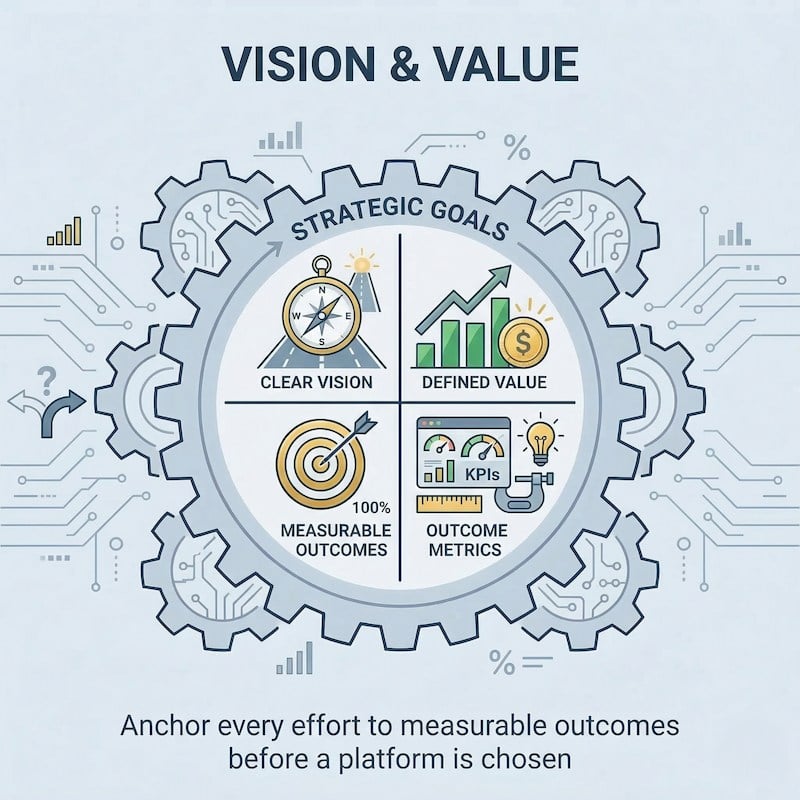
| V | Vision & Value | Anchor every effort to measurable outcomes before a platform is chosen |
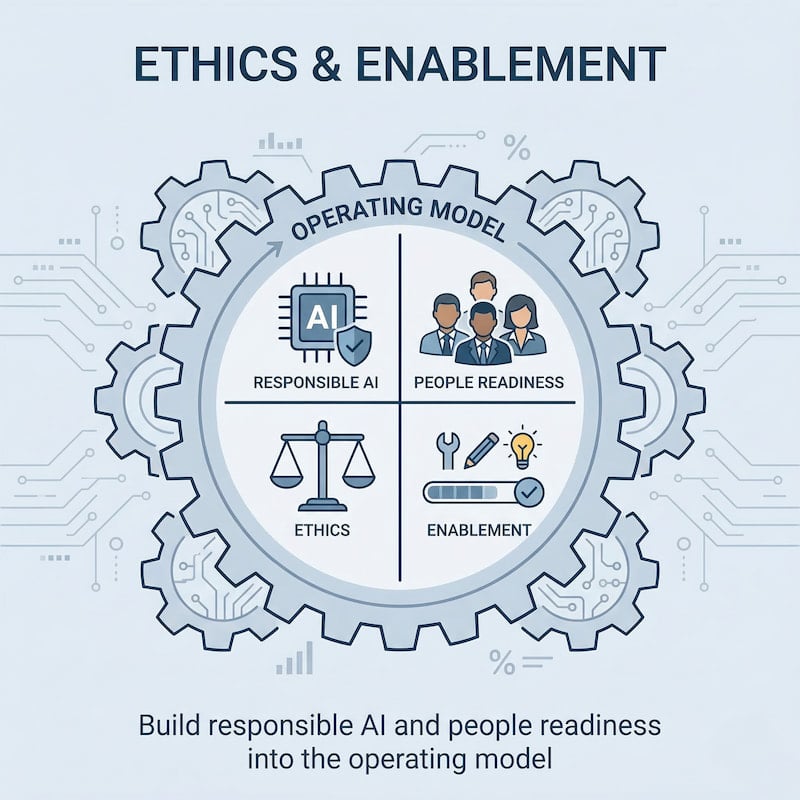
| E | Ethics & Enablement | Build responsible AI and people readiness into the operating model |
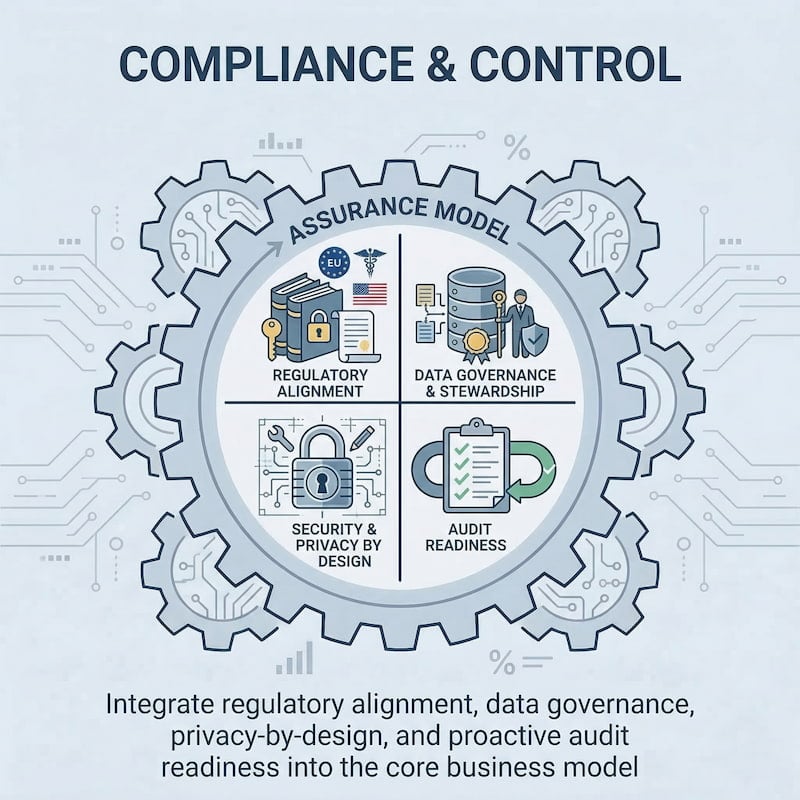
| C | Compliance & Control | Make governance, data integrity, and audit readiness foundational — not reactive |
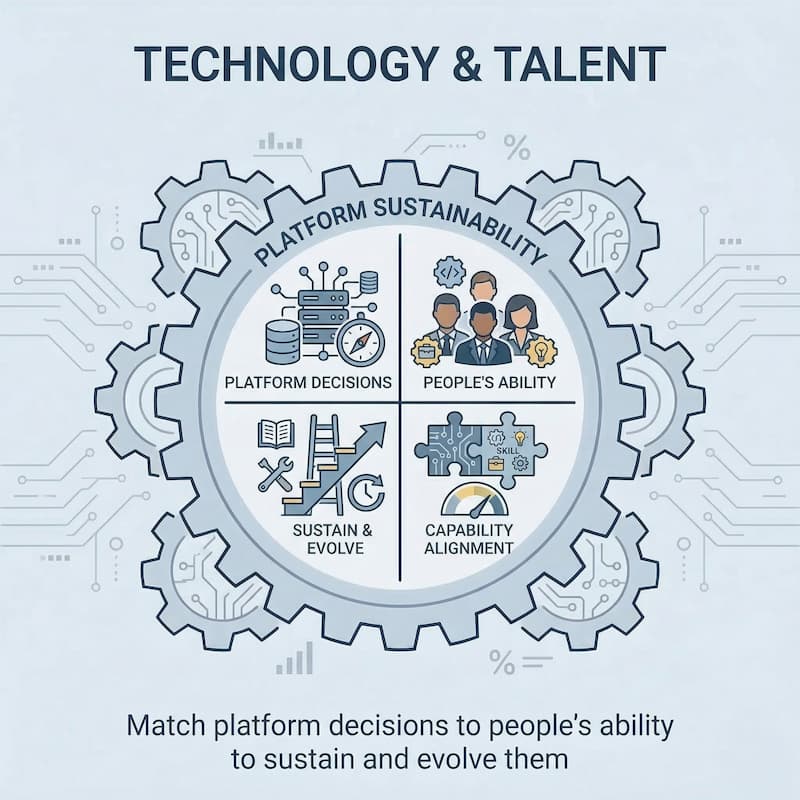
| T | Technology & Talent | Match platform decisions to people's ability to sustain and evolve them |
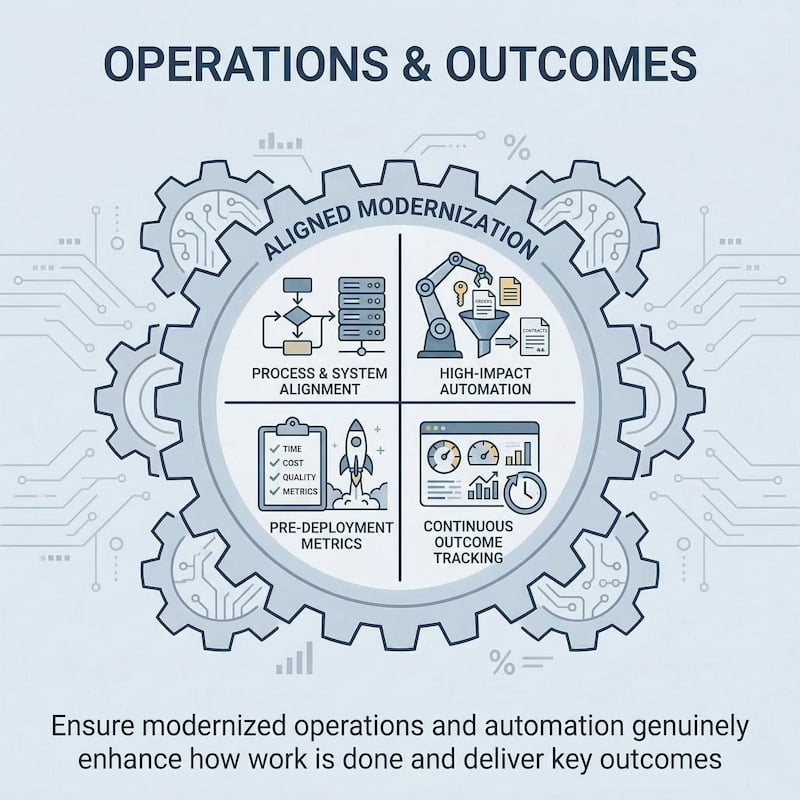
| O | Operations & Outcomes | Ensure modernization improves how work actually gets done |
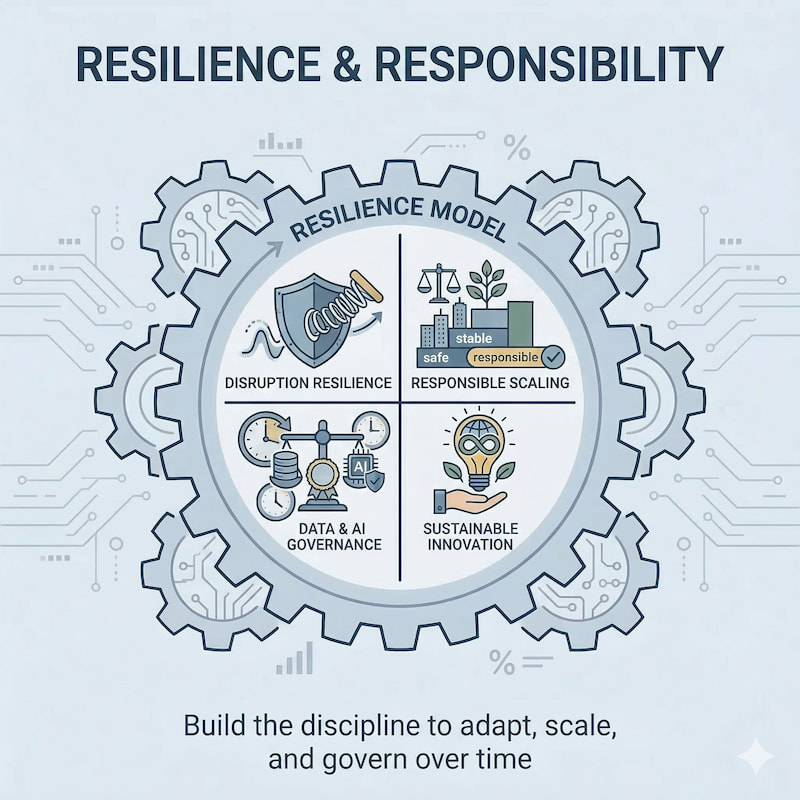
| R | Resilience & Responsibility | Build the discipline to adapt, scale, and govern over time |
The Six Pillars of VECTOR — and Why Each One Matters
V — Vision & Value
Most modernization efforts begin with tools. VECTOR begins with outcomes.
Before a platform is selected, a data initiative launched, or an AI use case approved, leaders need clarity on what must materially improve — and how that value will be measured. That sounds obvious. It’s often skipped anyway.
| A COMMON SCENARIO
A sales organization completes a CRM implementation on time and on budget. But six months later, pipeline visibility hasn’t improved, forecast accuracy is still unreliable, and sales leadership doesn’t trust what’s in the system. The technology worked. The outcome didn’t. Nobody defined — upfront — what “success” actually meant for the business. |
VECTOR forces those questions to the surface before the project begins:
- What needs to change — specifically?
- How will success be measured?
- Who owns the outcome?
- What will prove this investment was worth it?
Without that clarity, modernization becomes activity — not progress. Learn how our Data, Analytics, and AI Advisory Services can help.
E — Ethics & Enablement
Modernization isn’t successful just because the new technology works. It succeeds when people can use it well, trust it, and operate responsibly within it.
Teams need more than training. They need clarity on decision rights, process changes, ownership, and expectations. Leaders need confidence that users are not just aware of the new system, but actually equipped to work differently because of it.
This pillar becomes even more critical as organizations bring automation and AI into the mix. When AI influences recommendations, decisions, or next-best actions, leaders need assurance that its use is transparent, accountable, ethical, and appropriate.
But even outside AI, modernization raises practical questions around trust, adoption, and readiness:
- Are teams prepared to use the new environment effectively?
- Do they understand what is changing and why?
- Are they empowered to act — or still dependent on a few experts behind the curtain?
VECTOR embeds responsible AI and adoption discipline before automation begins:
- Transparency and explainability
- Bias awareness and mitigation
- Clear accountability for AI-driven outcomes
- Structured change management and workforce enablement
| A COMMON SCENARIO
An organization deploys an AI-assisted tool to help service teams prio ritize cases. The model works technically. But teams don’t understand how it makes decisions, don’t trust its recommendations, and quietly route around it. Adoption stalls. The tool sits unused. No one defined accountability, transparency standards, or change readiness before go-live |
This is where most AI initiatives fail — not technically, but culturally and ethically.
C — Compliance & Control
This is where many programs get reactive. Governance shows up after problems surface. Data controls tighten only after reporting breaks down. Security gets revisited after integration expands. Audit concerns emerge once leaders realize they can’t explain how something works — or who approved it.
VECTOR brings those questions forward by making compliance, governance, and data integrity foundational rather than reactive. This includes:
- Regulatory alignment (GDPR, HIPAA, CCPA, FERPA, and more)
- Data governance and stewardship
- Security and privacy by design
- Audit readiness as a default state
For some organizations, this is driven by regulatory requirements. For others, it’s driven by operational reality. Either way, the need is the same: modernization has to be governable.
That includes how data is defined, who owns it, how access is managed, and how decisions are audited over time.
That matters whether a team is modernizing Salesforce, integrating core systems, standing up analytics capabilities, or expanding automation across customer and service workflows.
| A COMMON SCENARIO
An organization builds a robust analytics environment and begins sharing data-driven reports with leadership. When an auditor asks how a key metric is calculated — and who approved that definition — no one can answer clearly. The data is there. The governance isn’t. What looked like a reporting success becomes a credibility problem. |
Without control, modernization creates fragility. Learn how our Data Governance and Compliance services can help.
T — Technology & Talent
Modernization collapses when technology advances faster than people can absorb it.
Technology decisions matter. So does the organization’s ability to sustain them. A modern platform is only as effective as the architecture around it and the people responsible for operating it. That means asking harder questions earlier.
VECTOR treats both technology and talent enablement as first-class concerns:
- Is the platform fit for purpose — or just familiar?
- Will the architecture scale as needs evolve?
- Are integrations designed thoughtfully, or patched together for speed?
- Are business users empowered, or still dependent on IT?
- Can the organization sustain this solution after consultants leave?
- Do users and administrators have the right capabilities to keep the momentum going?
This is where many organizations underestimate the work. They focus heavily on what to buy or build, but not enough on whether the business can actually absorb, manage, and evolve it.
| A COMMON SCENARIO
A company implements a sophisticated data platform with a capable consulting team driving delivery. The platform is well-designed. But when the engagement ends, the internal team doesn’t have the skills or documentation to maintain it. Within a year, the environment has drifted, pipelines are breaking quietly, and the organization is back to relying on manual workarounds. |
Modernization that outruns internal readiness doesn’t stay modern for long. Learn how our Technology Modernization services can help.
O — Operations & Outcomes
If modernization doesn’t improve day-to-day operations, it’s not delivering enough value.
That doesn’t mean every initiative must show immediate transformation. It does mean the connection between systems, workflows, and measurable outcomes needs to be explicit.
VECTOR forces a hard question:
Does this solution actually make work better?
- Are processes improving — or just being mirrored in a new platform?
- Is automation reducing friction, or adding complexity?
- Are teams getting better visibility, faster execution, and more consistent decisions?
- Are the right metrics defined before deployment — not retrofitted after launch?
This is especially important in environments where leaders are trying to modernize multiple functions at once. Sales, service, operations, analytics, and customer experience are deeply connected. If one part changes without the others, the business feels it quickly.
This VECTOR pillar ensures:
- Processes are aligned to systems, not overridden by them.
- Automation targets high-impact workflows.
- Metrics are defined before deployment.
- Outcomes are tracked continuously, not post-mortem.
| A COMMON SCENARIO
A service organization automates a core customer workflow to reduce handling time. The automation works as designed. But it was built around the old process — one that was already inefficient. The result: a faster version of a broken workflow. Handle time drops slightly. Customer satisfaction doesn’t move. The outcome that mattered was never defined before the build began. |
This is where strategy becomes reality — or quietly disappears.
R — Resilience & Responsibility
The real test of modernization isn’t go-live. It’s endurance.
It’s what happens six months later. After leadership changes. After market conditions shift. After regulations evolve, or after new technologies get layered on top of what was just implemented.
That is why resilience matters.
Organizations need the ability to adapt without creating chaos, with operating discipline, governance, release management, and accountability that can hold up as complexity increases.
They also need leadership maturity around responsibility — not just for cost and performance, but for how modernization decisions affect customers, employees, risk posture, and long-term agility.
This is especially relevant now as data and AI become part of broader modernization agendas.
VECTOR ensures organizations can:
- Withstand disruption
- Scale responsibly
- Adapt without chaos
- Govern AI and data over time
- Align innovation with long-term sustainability and impact
| A COMMON SCENARIO
An organization completes a successful ERP modernization. Eighteen months later, the business acquires a new division and needs to integrate it quickly. But the original implementation wasn’t designed with extensibility in mind. Integration becomes a costly, high-risk project that could largely have been avoided with more resilient design choices up front. |
In an era of constant change, resilience and responsibility aren’t optional. They’re fundamental to leadership.
Why VECTOR Is Especially Critical for Data & AI
Data and AI don’t just add complexity to modernization; they amplify everything.
Good decisions become better. Bad assumptions become dangerous. Weak governance becomes visible. Ethical gaps become public.
That’s why organizations cannot treat data and AI as side projects sitting next to their IT modernization strategy. They are part of the modernization challenge now.
When the foundation is strong, data and AI can accelerate value. When it’s weak, they amplify problems and confusion.
Responsible organizations are asking different questions. Not just “Can we implement this?” — but: Can we govern it? Can we trust it? Can we sustain it? Can we prove it’s helping the business perform better?
| Without VECTOR | With VECTOR |
|---|---|
| AI becomes experimental instead of operational | AI is explainable, governed, and accountable |
| Data becomes plentiful but untrusted | Data is reliable, integrated, and decision-ready |
| Automation accelerates risk instead of value | Modernization earns confidence — not skepticism |
VECTOR doesn’t slow innovation. It makes innovation defensible, scalable, and sustainable.
What Organizations Risk Without a Modernization Framework
Modernization is no longer a simple handoff from strategy to implementation. It requires a way to connect business priorities, governance, technology, operations, and long-term accountability as change moves from vision into execution.
The cost of skipping that discipline is real. Organizations that approach IT modernization without a unifying framework tend to follow the same arc:
- Low adoption despite high spend
- AI pilots that never scale beyond the demo
- Regulatory exposure discovered too late
- Executive frustration and change fatigue
- “We need another transformation” cycles that erode confidence
Organizations that apply a disciplined IT modernization framework like VECTOR:
- Align strategy and execution faster
- Surface and de-risk problems earlier
- Deliver measurable, auditable outcomes
- Build trust with stakeholders, boards, and regulators
- Sustain value long after go-live — without rebuilding from scratch
In a market where the pressure is to move faster, adopt AI responsibly, and modernize without creating new risk, discipline is becoming a competitive advantage. That’s what VECTOR is designed to support.
The Bottom Line
Success in IT modernization doesn’t belong to the organizations with the most technology. It belongs to the ones using it responsibly and with the most discipline.
The scenarios above aren’t edge cases. They’re patterns — ones Summit sees across industries, initiative types, and investment levels. The organizations that break these patterns share one thing in common: they treat modernization as an operating challenge, not just an implementation project.
If your organization is serious about IT modernization, data-driven decision-making, responsible AI, regulatory confidence, or long-term operational resilience — a disciplined IT modernization framework like VECTOR isn’t optional. It’s how the work holds together.
VECTOR helps organizations modernize with greater clarity, stronger controls, better alignment, and a sharper focus on measurable outcomes.
Is Your IT Modernization Effort Built to Deliver?
Many organizations are already mid-initiative when they realize their strategy, governance, and operations aren’t as aligned as they thought. The cost of that misalignment — in rework, lost adoption, and delayed value — is almost always avoidable.
Summit works with organizations navigating modernization across platforms, data, operations, and AI. We use the VECTOR Framework as a practical diagnostic and execution tool — not a theoretical exercise.
Learn more about our data, analytics, and AI consulting services.
A focused conversation can quickly surface where your effort is strong — and where it’s quietly at risk.